
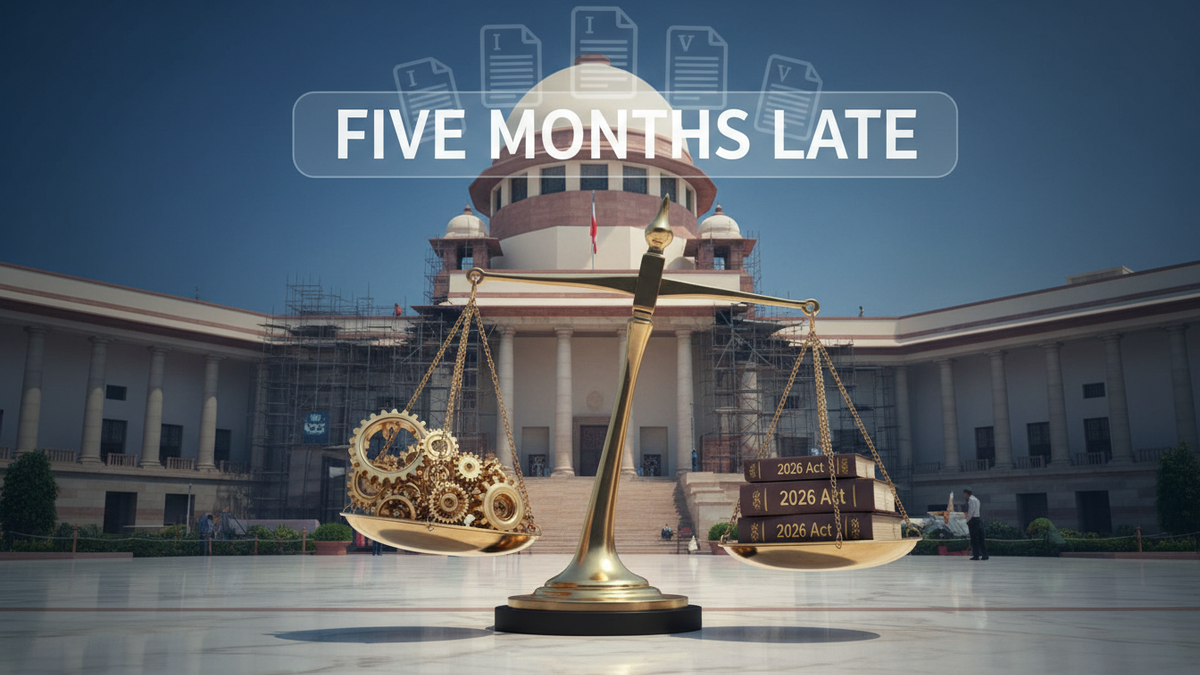
On November 19, 2025, a two-judge bench of the Supreme Court — Chief Justice B.R. Gavai and Justice K. Vinod Chandran — did something Parliament had been avoiding for eight years: it set a deadline. In Madras Bar Association v. Union of India (2025 SCC OnLine SC 2498), the Court struck down Sections 3 to 7 of the Tribunals Reforms Act, 2021 — the provisions governing how tribunal members are appointed, how long they serve, and how they can be removed — and ordered the Union government to set up a National Tribunals Commission within four months. Missing that deadline meant the Court’s patience, worn thin by repeated rounds of litigation over the same questions since 2017, had finally run out.
Parliament missed it. The Tribunals Reforms Bill, 2026 cleared the Lok Sabha on August 10 and the Rajya Sabha a day later, and President Droupadi Murmu gave her assent on August 13, 2026 — nearly five months after the Court’s own deadline lapsed, and roughly nine months after the judgment itself. The resulting Tribunals Reforms Act, 2026 is Parliament’s fifth attempt since 2017 to settle who controls India’s tribunals: the executive that funds and staffs them, or the judiciary that is constitutionally meant to guarantee their independence. Whether this attempt actually ends the cycle, or merely repackages it once more, is now the live question.
Why the Supreme Court Ran Out of Patience
The dispute is older than most of the tribunals it concerns. In Union of India v. R. Gandhi (2010) and again in Madras Bar Association v. Union of India (2014), the Supreme Court held that when Parliament transfers judicial functions from courts to tribunals, those tribunals must be staffed and administered in a manner that preserves the same independence a court would have — parity with High Court judges in tenure, service conditions, and freedom from executive interference. Part XIV of the Finance Act, 2017 tested that principle by handing the Union government sweeping rule-making power over the qualifications, appointment, and removal of tribunal members across twenty-five different statutes. A five-judge Constitution Bench in Rojer Mathew v. South Indian Bank Ltd. (2019) found the delegation excessive and flagged short, renewable tenures as corrosive of judicial independence — reasoning that a member reappointable at the executive’s pleasure has every incentive to decide in the executive’s favour.
The government’s response was the Tribunals Reforms (Rationalisation and Conditions of Service) Ordinance, 2021, reissued as the Tribunals Reforms Act, 2021 after a three-judge bench (Justices L. Nageswara Rao, S. Ravindra Bhat and Hemant Gupta) struck down the ordinance’s four-year tenure cap and lopsided Search-cum-Selection Committee in the July 2021 round of Madras Bar Association. The 2021 Act simply re-enacted the same fixed four-year term and the same Committee structure the Court had just invalidated. That set up the November 2025 confrontation: the Gavai bench found the 2021 Act had, in substance, ignored the 2021 judgment, quashing its appointment, tenure and removal provisions (Sections 3–7) and observing that it was “unfortunate that instead of giving effect to well-established principles, the legislature has chosen to re-enact provisions” already held unconstitutional. This time, rather than leave the vacuum to executive rules, the Court ordered Parliament to legislate a permanent institutional fix — a National Tribunals Commission — within four months, with judicial dominance built into its structure.
What the Tribunals Reforms Act, 2026 Actually Does
The Act creates the National Tribunals Commission (NTC) as a standing body responsible for the appointment process, performance oversight, and service conditions of members across sixteen tribunals — among them the Central Administrative Tribunal, the National Green Tribunal, the National Company Law Appellate Tribunal, the National Consumer Disputes Redressal Commission, the Armed Forces Tribunal and the Income Tax Appellate Tribunal.
Composition of the Commission
The NTC has five members: a chairperson who must be a former Supreme Court judge or a former High Court Chief Justice, two judicial members drawn from former High Court Chief Justices or judges, and two technical members with at least twenty-five years’ experience in fields such as public administration, finance, law, accountancy, banking or management. The central government makes these appointments, but the chairperson and judicial members can only be appointed in consultation with the Chief Justice of India — language borrowed directly from Article 124’s model for Supreme Court appointments. Commission members serve five years or until age 70, whichever is earlier.
The Search-Cum-Selection Committee
For each vacancy, a Search-cum-Selection Committee recommends a candidate. Its composition varies slightly by post, but broadly comprises the Commission’s chairperson or a judicial member as head, a retired High Court judge, a technical member of the Commission, a Secretary to the central government, and two subject-matter experts — with the Commission’s own Secretary attending in a non-voting capacity. Critically, the two expert members and the Commission Secretary have no vote; among the four voting members, three sit on the judicial side of the table (the judicial chair, the retired judge, and — depending on classification — the technical member) against a single government Secretary, and the committee head holds a casting vote in the event of a tie. On paper, that is a meaningfully more judiciary-weighted structure than the 2021 Act’s committee, which gave the executive-nominated Member-Secretary no vote either but still left judicial members without a guaranteed majority in practice.
Tenure and Removal
Tribunal chairpersons serve five years or until age 70; other members serve five years or until age 67 — longer and more uniform than the four-year term the Court twice struck down. The Union can remove a member unilaterally only for narrow, largely undisputed grounds such as insolvency or a conviction involving moral turpitude. For contested grounds — misconduct, incompetence, inefficiency, or abuse of position — removal requires a formal inquiry, and for Commission members that inquiry must be headed by a sitting Supreme Court judge, a safeguard the 2021 regime never provided.
The National Tribunals Data Grid
The Act also directs the NTC to maintain a National Tribunals Data Grid, a case-tracking and performance database intended to bring the same transparency to tribunal pendency that the e-Courts project brought to the regular judiciary, and requires the Commission to publish an annual performance report.
Where the Fix Still Falls Short
The Act answers the Court’s core demand — a standing Commission with judicial representation replacing ad hoc executive rule-making — but commentators have flagged real gaps between the design and true judicial primacy. Prashant Reddy T., writing for Supreme Court Observer, points out that the Act borrows Article 124’s “consultation” language for NTC appointments without settling whether that consultation binds the Union or is merely advisory — precisely the ambiguity that has fuelled decades of dispute over how much weight executive “consultation” with the Chief Justice must actually carry. His analysis also flags the stage before a formal inquiry is even triggered: he argues that letting the government be the initial recipient and screener of complaints against tribunal members, ahead of any judge-led inquiry, still hands practical gatekeeping power to what he calls “faceless bureaucrats,” even though the inquiry itself is judicially led. And while the NTC controls appointments and performance oversight, it has no responsibility for tribunal infrastructure or staffing, which remains tied to the respective parent ministries — meaning a tribunal can have a judicially-vetted member but still depend on the executive department it may be adjudicating against for its courtroom, its registry staff, and its budget.
None of this is likely to end the litigation. Given that this is the fifth legislative or rule-based attempt to fix tribunal governance since the 2017 Finance Act — after the 2017 Rules, the 2020 Rules, the 2021 Ordinance and the 2021 Act were each challenged in turn — a further round of scrutiny in Madras Bar Association-style proceedings, testing whether “consultation” in practice means what the Court intended, would fit the pattern rather than break it.
What This Means for Indian Legal Professionals and Litigants
For lawyers practising before the CAT, NCLAT, NGT, ITAT, NCDRC and the other tribunals the Act covers, the most immediate practical change is procedural: appointments and vacancies that have often dragged on for months under ad hoc executive processes are now meant to route through the standing Commission and its Search-cum-Selection Committees, which should, if implemented as designed, reduce the chronic vacancy-driven pendency that has plagued forums like the NCLAT in recent years. The National Tribunals Data Grid, once operational, should also give practitioners far better visibility into case backlogs and average disposal times across tribunals — information that has historically been difficult to obtain in any centralised form.
For litigants and businesses that rely on tribunals for anything from company law disputes to environmental clearances to service matters, the deeper stake is one of confidence: whether a member deciding a case against a government department or a well-resourced corporate litigant is genuinely insulated from pressure over their next term or their next posting. The 2026 Act moves the formal structure closer to that guarantee than anything Parliament has enacted since 2017. Whether it moves the substance closer is a question the Supreme Court, on the evidence of the last eight years, is unlikely to leave unexamined for long.
Frequently Asked Questions
What is the National Tribunals Commission and why was it created?
The National Tribunals Commission (NTC) is a new standing body created by the Tribunals Reforms Act, 2026 to handle appointments, service conditions, and performance oversight for members of sixteen central tribunals. It was created because the Supreme Court, in its November 2025 judgment in Madras Bar Association v. Union of India, ordered the Union government to set up such a body within four months after finding that letting the executive directly control tribunal appointments and removals violated the separation of powers and judicial independence.
Did Parliament meet the Supreme Court’s deadline for creating the NTC?
No. The Supreme Court’s four-month deadline from its November 19, 2025 judgment expired around mid-March 2026. The Tribunals Reforms Bill, 2026 was not passed by both Houses of Parliament until August 10–11, 2026, and received presidential assent on August 13, 2026 — several months after the ordered deadline.
How is the National Tribunals Commission different from the tribunal oversight body under the 2021 Act?
The Tribunals Reforms Act, 2021 left appointments largely to Search-cum-Selection Committees convened case-by-case, with rules the Supreme Court twice found to under-represent judicial members and to impose a fixed four-year tenure it held was too short to guarantee independence. The 2026 Act instead creates a permanent five-member Commission, led by a former Supreme Court judge or High Court Chief Justice appointed in consultation with the Chief Justice of India, with a longer and more standard tenure (five years, or up to age 70 for chairpersons and 67 for members) across all covered tribunals.
Which tribunals are covered by the Tribunals Reforms Act, 2026?
The Act covers sixteen central tribunals, including the Central Administrative Tribunal, the National Green Tribunal, the National Company Law Appellate Tribunal, the National Consumer Disputes Redressal Commission, the Armed Forces Tribunal, and the Income Tax Appellate Tribunal, among others.
What criticisms have been raised about the new Act?
Legal commentators have flagged that the Act does not clarify whether the Union’s “consultation” with the Chief Justice of India on Commission appointments is binding, that the process for screening complaints against tribunal members still gives the government an initial gatekeeping role before any inquiry is ordered, and that tribunal infrastructure and staffing remain dependent on parent ministries even though appointments now run through the Commission.
Does this Act end the litigation over tribunal independence in India?
Not necessarily. This is the fifth legislative or rule-based attempt to settle tribunal governance since the Finance Act, 2017, and each of the previous four was challenged in the Supreme Court. Ambiguities in the 2026 Act’s consultation and removal provisions leave room for similar challenges if they are implemented in a way that favours executive control in practice.
Sources
- SC Quashes Key Provisions Of Tribunals Reforms Act, 2021; Directs Centre To Establish National Tribunals Commission — SCC OnLine - Coverage of the November 19, 2025 judgment in Madras Bar Association v. Union of India ordering the NTC’s creation.
- Tribunals Reforms Act, 2026 Gets President’s Assent — Bar and Bench - Details on the Bill’s passage dates and presidential assent.
- New Tribunal Law Raises More Questions Than Answers — Supreme Court Observer - Analysis by Prashant Reddy T. of gaps in the 2026 Act’s appointment and removal provisions.
- The Tribunals Reforms Bill, 2026 — PRS Legislative Research - Detailed bill summary including Commission and Search-cum-Selection Committee composition.
- The Long Overdue Tribunals Reforms Bill, 2026 — ThePrint - Overview of the National Tribunals Data Grid and other provisions.
- Parliament Passes Tribunals Reforms Bill, 2026 — ThePrint - Report on the Lok Sabha and Rajya Sabha passage dates.
- Madras Bar Association vs Union of India, 14 July 2021 — Indian Kanoon - Full text of the 2021 judgment striking down the Tribunals Reforms Ordinance provisions.
- Rojer Mathew vs South Indian Bank Ltd and Ors, 13 November 2019 — Indian Kanoon - Full text of the Constitution Bench judgment on the Finance Act, 2017’s tribunal provisions.