
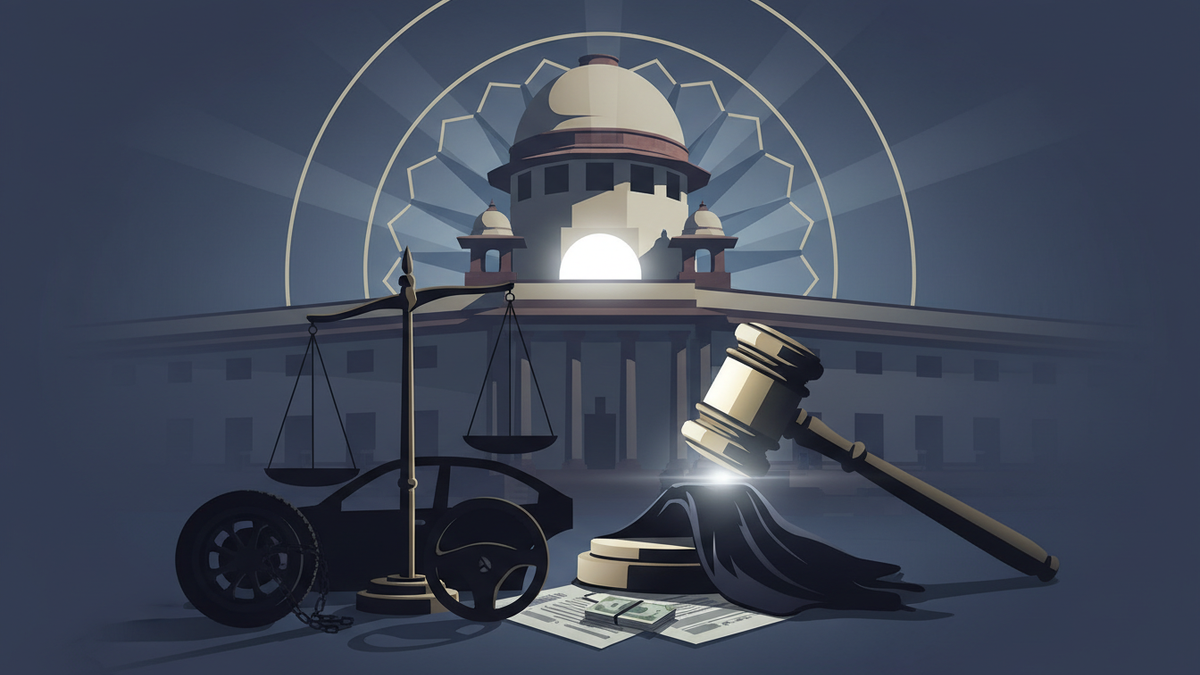
On the night of April 9, 2023, a truck belonging to Hari Dutta Sharma was seized from outside his house in Uttar Pradesh at 1 a.m., its steering lock broken open by men working for the finance company that held a lien on the vehicle. There was no notice, no warrant, no opportunity to explain the missed instalments. Three years later, on September 16, 2026, a two-judge Bench of the Supreme Court — Justices P.S. Narasimha and Alok Aradhe — used Sharma’s case to lay down, in unusually blunt language, exactly how far a lender can go when a borrower defaults, and how far Indian banks and non-banking financial companies (NBFCs) have strayed from that line. Hari Dutta Sharma v. State of U.P. & Ors., reported as 2026 LiveLaw (SC) 942, matters far beyond one truck owner: crores of Indians finance two-wheelers, cars, tractors and commercial vehicles through hypothecation loans, and repossession-by-muscle-power has been a persistent, largely unpoliced practice across that market.
The Facts: A Loan, a Default, and a Midnight Seizure
Sharma had financed a Tata SFC 407 truck through Cholamandalam Investment and Finance Company Limited in 2019, borrowing roughly ₹10.4 lakh, of which ₹9.36 lakh was actually disbursed, plus a supplementary loan of ₹1.04 lakh. The vehicle was hypothecated to the company as security. When Sharma fell behind on his instalments, the company did not go to court, issue a statutory notice, or use any of the recovery mechanisms available to secured lenders. Instead, on April 9, 2023, its agents broke open the truck’s steering lock in the dead of night and drove it away. By August 31, 2023, the truck had already been sold — and the company continued pursuing Sharma for the outstanding balance even after taking and disposing of the asset.
Sharma challenged the repossession before the Allahabad High Court. The Division Bench dismissed his writ petition, reasoning that the vehicle had already been sold by the time he approached the court, that he had defaulted on his instalments, and that he had moved belatedly. It was that dismissal the Supreme Court set aside.
What the Supreme Court Held
Self-Help Repossession Is Not a Licence for Force
The Bench did not dispute that Sharma had defaulted, or that Cholamandalam had a contractual right to repossess the hypothecated vehicle. Its objection was to how that right was exercised. Justice Narasimha, writing for the Bench, observed that a self-help repossession clause in a loan agreement risks becoming “an unbridled licence to seize property by stealth, by force or in the dead of night” if lenders are allowed to invoke it without any procedural check. The Court held that recovery of loans or seizure of hypothecated vehicles “could only be made through lawful means” — echoing, and expressly relying on, the Court’s own two-decade-old warning in ICICI Bank Ltd. v. Prakash Kaur (2007), where it had already deprecated banks employing musclemen — “goondas,” in the Court’s own word — to seize vehicles by force rather than through legally recognised procedure.
The Repossession Right Had Never Even Accrued
Significantly, the Court did not stop at general disapproval of strong-arm tactics — it scrutinised the specific repossession clause, Article 11 of Cholamandalam’s loan agreement, on its own contractual terms. Article 11(a)(i) made the company’s right to repossess conditional on giving the borrower seven days’ advance notice. The Bench found that no such notice was ever issued to Sharma before his truck was seized. On the agreement’s own wording, that meant the conditional right of repossession had never even accrued to the financier in the first place — so the seizure was not merely conducted badly, it was carried out without any contractual right to do so at all.
RBI’s Guidelines “Existed Only on Paper”
The Court then turned from the individual contract to the regulatory backdrop, and its tone sharpened further. It noted that the Reserve Bank of India already has a Fair Practices Code for lenders — issued under its Master Circulars and directions to NBFCs and banks, which draw statutory force from Section 35A of the Banking Regulation Act, 1949 — that expressly bars the use of “muscle power,” harassment, contact at inappropriate hours, and intimidation of borrowers by recovery agents, and requires lenders to give reasonable prior notice before repossessing a financed vehicle. The Bench’s finding was that these guidelines have, in practice, “existed only on paper,” with banks and NBFCs across the country routinely ignoring them. Rather than treating that gap as Cholamandalam’s problem alone, the Court directed the RBI itself to “take effective steps to secure genuine compliance” by all scheduled commercial banks and NBFCs, and ordered its registry to send a copy of the judgment directly to the regulator.
The Relief Granted
Having found the repossession, sale, and continued recovery effort against Sharma unlawful, the Court ordered Cholamandalam to close his loan account entirely and to refund the ₹4.5 lakh it had realised from selling his truck, with 6% annual interest running from the date of sale. On top of that restitutionary relief, the Bench awarded ₹10 lakh in compensation for the mental agony and loss of livelihood the seizure caused — a truck is, for an owner-driver, not a possession but a source of income — along with ₹50,000 in litigation costs.
Why This Fits a Wider Pattern
Sharma’s case does not stand alone. Courts have been circling this issue from multiple directions this year: the Uttarakhand High Court, in Savitri Devi v. ICICI Bank Ltd. & Ors. (2026 UHC 3157), separately held that repossessing a financed vehicle through recovery agents without following due process violates the constitutional guarantee under Article 300A that no person shall be deprived of property save by authority of law. Read together, these rulings signal that appellate and constitutional courts are no longer treating loan-recovery overreach as a private contractual dispute to be sorted out between borrower and financier — they are treating it as a rule-of-law problem that regulators have failed to fix.
Practical Implications
For Lenders and NBFCs
Financiers who rely on self-help repossession clauses now face a two-fold risk after this ruling. First, courts will hold lenders strictly to the notice conditions written into their own agreements — as Sharma’s case shows, skipping a contractually mandated notice period does not just weaken a repossession, it can mean the right to repossess never arose at all. Second, even where notice was given, a lender’s recovery agents cannot use force, deception, or midnight seizures to execute it: courts will look at actual conduct, not just contract language. Compliance functions and empanelled recovery agencies should be audited against both their own loan-document notice clauses and the RBI Fair Practices Code now, rather than after the next writ petition.
For Borrowers
For the ordinary vehicle-loan borrower — an overwhelmingly large population of truck, taxi, and two-wheeler owners across India — this judgment is a concrete precedent to cite the moment a vehicle is seized without notice or through force. It confirms that default does not forfeit a borrower’s right to a lawful process, that unlawful repossession can independently generate a compensation claim over and above the value of the asset itself, and that continuing to pursue “recovery” after an unlawful seizure and sale compounds the lender’s liability rather than curing it.
For the Regulator
The Court’s direction to the RBI is the least conventional — and potentially most consequential — part of the judgment. It is not addressed to a party before the Court at all, but to the regulator’s supervisory failure. Whether the RBI responds with fresh circulars, stricter NBFC audits, or actual enforcement action against repeat offenders will determine whether this judgment changes practice on the ground or simply adds one more precedent to a guideline regime the Court itself says has gone unenforced.
Frequently Asked Questions
Can a bank or NBFC still repossess my vehicle if I default on my loan?
Yes. A lender retains the contractual right to repossess a hypothecated vehicle after default, but the Supreme Court has now made clear that this right must be exercised through lawful means — with adequate prior notice, a defined procedure, and a genuine opportunity to cure the default — not through force, deception, or seizure without warning.
What should I do if my vehicle is repossessed at night or without notice?
Document the seizure as thoroughly as possible (time, agents involved, any damage), and challenge it before the appropriate forum — a consumer commission, a civil court, or, as in Sharma’s case, a writ petition — citing this judgment and ICICI Bank Ltd. v. Prakash Kaur (2007) as precedent that forcible, notice-less repossession is unlawful.
Does this ruling apply to NBFCs as well as banks, or only to banks?
It applies to both. The Court’s directions were addressed to the RBI to secure compliance across “scheduled commercial banks and NBFCs” alike, since NBFCs like Cholamandalam are themselves regulated entities subject to the RBI’s Fair Practices Code.
What is a self-help repossession clause, and is it now unenforceable?
It is a clause in a loan or hypothecation agreement allowing the financier to take back the asset directly on default, without first going to court. The Supreme Court did not strike down such clauses as a category, but held that a lender must strictly satisfy any conditions the clause itself imposes — in Sharma’s case, a mandatory seven-day notice under Article 11(a)(i) — and that skipping such a condition means the right to repossess never accrues in the first place, regardless of the underlying default.
Did the Supreme Court fine the RBI or penalise it in any way?
No. The Court did not impose any penalty on the RBI. It directed the regulator to take effective steps to secure genuine compliance with its own existing guidelines by banks and NBFCs, and ordered that a copy of the judgment be sent to the RBI, but set no specific compliance deadline or reporting mechanism.
How much compensation was awarded, and by whom?
Cholamandalam Investment and Finance Company Ltd. was directed to refund ₹4.5 lakh (the sale proceeds of the truck) with 6% annual interest, pay ₹10 lakh as compensation for mental agony and loss of livelihood, and pay ₹50,000 in litigation costs — in addition to closing Sharma’s loan account entirely.
Sources
- Financiers Cannot Repossess Vehicles By Force: Supreme Court Awards Rs 10 Lakh Compensation To Truck Owner - LiveLaw’s report on the judgment, case citation, and the Court’s core holding.
- Hari Dutta Sharma vs UP (2026 INSC 998): SC on Illegal Midnight Vehicle Repossession - detailed facts of the loan, default, and repossession.
- Supreme Court Slams Muscle Power, Awards ₹10 Lakh For Midnight Truck Seizure - Allahabad High Court’s dismissal and direct quotes from the Bench.
- SC Tells RBI To Rein In Forcible Vehicle Seizures - the RBI directive, Article 11 clause analysis, and the “unbridled licence” quote.
- SC asks RBI to ensure banks, NBFCs seize financed vehicle lawfully - Business Standard’s coverage of the regulatory directions.
- Manager, ICICI Bank Ltd. vs Prakash Kaur & Ors. (26 February, 2007) - full text of the 2007 precedent the Court relied on.
- Savitri Devi v. ICICI Bank Limited & Ors. (2026 UHC 3157) - the Uttarakhand High Court’s parallel Article 300A ruling on repossession without due process.
- RBI Recovery Guidelines ‘Exist Only On Paper’: Supreme Court Directs Effective Compliance By Banks, NBFCs - detail on the RBI Fair Practices Code and the Court’s compliance direction.