
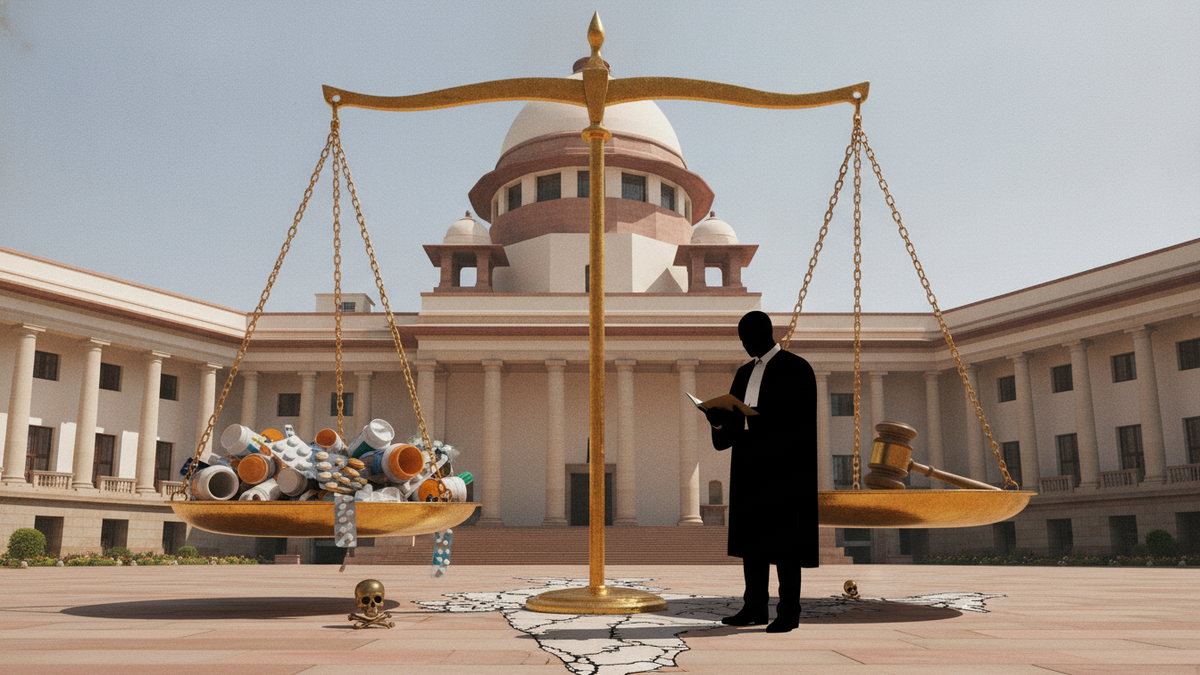
A woman in Kolkata sells the gold bangles her mother gave her at her wedding. A retired schoolteacher in Nagpur remortgages the flat he spent thirty years paying off. A daily-wage mason in Bhopal borrows from three different moneylenders in the same month. None of them has been robbed in the way the law usually understands that word. There was no knife, no broken lock, no masked man in the night. What they have in common is a diagnosis in the family, a prescription for a cancer drug, and a bill that does not seem to add up. Which is why it was so striking, on the twenty-second of September, to hear that word used anyway — from the bench of the Supreme Court of India itself. Hearing a set of public interest petitions on medicine pricing, Justices Vikram Nath and Sandeep Mehta were told that a cancer drug with a printed maximum retail price of ₹27,000 is supplied by its manufacturer to the retailer for about ₹2,700. A tenfold markup, on a medicine no patient chooses to need. “That is absolute rampage and carnage and broad daylight dacoity with the patients,” Justice Mehta said. Not negligence. Not a market inefficiency. Dacoity — armed robbery by a gang, the specific and serious offence Indian criminal law reserves for organised, violent theft. A sitting judge of the country’s highest court reached for that word, in open court, to describe how medicine is priced in India. The argument of this piece is that he was right to, and that the reason the word fits is not rhetorical excess but a precise description of a regulatory system that has, for one category of drugs, stopped functioning as regulation at all.
Start with what regulation is supposed to do here, because the gap only makes sense once you see the structure it is failing to fill. India controls drug prices through the Drugs (Prices Control) Order, 2013, administered by the National Pharmaceutical Pricing Authority. The NPPA fixes ceiling prices for medicines on the National List of Essential Medicines — the “scheduled” drugs, roughly a fifth of the market by the numbers cited to the Court. For everything else, the “non-scheduled” majority, the manufacturer sets the first price and the NPPA can only cap the annual increase, not the base. A drug can enter the market priced at whatever the manufacturer chooses, and as long as future increases stay within the permitted band, it can stay there indefinitely. Cancer drugs, overwhelmingly, sit in this second category. The Bench was told of a statin, Rosuvas, that costs roughly ₹214 a strip precisely because it escapes DPCO scheduling; the logic scales badly, and predictably, for oncology drugs where a full course can run into lakhs. This is not a black market or a smuggling racket. It is the ordinary, lawful operation of a pricing regime that regulates the rate of change and never asks whether the starting point was honest.
The second thing worth sitting with is who ultimately pays, because it is broader than the family standing at the pharmacy counter. Justice Mehta pressed the point that a large share of this spending now runs through the state itself — patients treated under Ayushman Bharat, India’s flagship health insurance scheme, at hospitals that buy the medicine at inflated rates and bill the government for the difference. “It’s ultimately taxpayer’s money,” he observed. “There is a clear-cut case of fraud.” That reframes the entire question. This is not only a story about a family choosing between a mortgage and a father’s chemotherapy, wrenching as that choice is. It is a story about public money — collected from every taxpayer, meant to insure the poorest patients against catastrophic health costs — flowing through a pricing gap that a scheme of unregulated first prices leaves wide open. A compliance officer at a hospital chain, a finance official structuring an insurance payout, an investor pricing risk in the diagnostics or hospital sector: all of them are, whether they have thought about it this way or not, operating inside a market where the sticker price of a critical input may bear only a loose relationship to its cost of production. That is not a footnote to the case. It is the case.
None of this is happening for the first time, which is itself part of the argument. In 2019, the NPPA capped trade margins on forty-two non-scheduled anti-cancer drugs at thirty percent, after public pressure over exactly this kind of markup, and the government’s own estimates projected annual savings to patients running into hundreds of crores. It was, at the time, presented as a template — a targeted fix that regulators could extend, drug by drug, wherever margins ran wild. Health rights groups, including the All India Drug Action Network, warned even then that the intervention would be too narrow, covering a handful of brands while leaving the rest of the market untouched, and that manufacturers would simply route around a cap on margins by adjusting the base price instead. Seven years on, the Supreme Court is looking at a fresh cancer drug with a tenfold gap between transfer price and MRP, and the drug in question is not one of the forty-two. The lesson is not that trade margin capping was a bad idea. It is that a patchwork of caps on individual brands cannot substitute for pricing transparency at the point where a drug first enters the market, because the industry will always have more molecules than the regulator has bandwidth to name.
It is worth asking, too, whether India needs to invent a fix from scratch or whether it can simply borrow one. Most of the world’s major pharmaceutical markets already regulate first prices through some version of external reference pricing — comparing the price a manufacturer proposes in one country against the prices already charged for the same molecule in a defined basket of other countries, and using that comparison to negotiate or cap the launch price before it ever reaches a pharmacy shelf. France and the Netherlands do it with a basket of four reference countries; Canada uses seven; Spain uses more than twenty; and the practice has spread well beyond the OECD, to Brazil, South Africa, Jordan and Turkey, none of which are wealthier than India and all of which regulate new drug prices more tightly at the point of entry than India currently does for anything outside the DPCO schedule. India is not short of comparators to study, or short of the administrative capacity the NPPA already has to run such a comparison — it is short of a legal mandate requiring the comparison be made before a manufacturer, not after a Supreme Court bench, decides what a course of chemotherapy should cost.
It would be too easy, and also unfair, to treat this purely as villainy. The pharmaceutical industry’s defence of wide margins on non-scheduled drugs is not frivolous, and a serious argument has to reckon with it rather than wave it away. Manufacturers and their trade associations argue that healthy margins on the unregulated segment cross-subsidise the research and development that scheduled, price-capped drugs cannot support on their own; that rising costs of active pharmaceutical ingredients, many still imported, are absorbed somewhere in the chain; and that a blunt, market-wide cap on trade margins risks making thin-margin generics unprofitable to stock, which in the past has led wholesalers and small retailers to warn of shortages rather than savings. The industry’s own submissions on trade margin rationalisation have consistently asked for a graded, phased approach precisely to avoid destabilising the supply chain for medicines that are, unlike scheduled drugs, genuinely at risk of going out of stock if the economics turn hostile. There is a real policy trade-off buried in this argument: too light a touch and patients are, in Justice Mehta’s word, robbed; too blunt an instrument and the shelves that stock those very cancer drugs could thin out. But acknowledging the trade-off is not the same as accepting a tenfold gap between transfer price and retail price as its price of admission. Between a system with no first-price scrutiny at all and a system that name-checks forty-two brands and calls it a day, there is a wide, currently unoccupied middle ground: mandatory disclosure of the transfer price at the point of first sale, so that a ten-times markup cannot hide behind an MRP sticker the way it does today. Transparency is a materially smaller intervention than a price cap, and it is difficult to see what legitimate R&D or supply-chain interest it threatens.
What should trouble a legal professional here, more than the specific number, is how much regulatory architecture already exists on paper and how little of it is actually visible to the patient standing at the counter. India has a price-control order. It has a pricing authority with statutory powers under Section 3 of the Essential Commodities Act, from which the DPCO draws its authority. It has, since 2008, a network of Jan Aushadhi Kendras selling generic versions of many of these same molecules at a fraction of the branded price — a genuinely good policy, undermined by the fact that the Bench was told these stores account for less than one percent of the pharmaceutical retail market by value. It has, in Ayushman Bharat, a reimbursement architecture that could in principle demand cost transparency as a condition of empanelment, and largely does not. Each of these pieces, individually, looks like a government that has done something about drug pricing. Stacked together, they describe a state that has built an impressive amount of regulatory furniture around a room it has declined to actually secure. That is the deeper indictment in “broad daylight” — not that the theft happens in daylight because no one is watching, but that it happens in daylight because everyone is watching, and has been for years, and the machinery built to stop it has been calibrated to catch a fraction of the cases while leaving the rest in full view.
This is also, and this is easy to lose in the outrage, a story about the ordinary weakness of case-by-case public interest litigation as a fix for a market-wide failure. The Supreme Court can order the Union government to explain itself, and it has, with the matter now listed for a further hearing on the twenty-ninth of September. It can shame a bench of ministries into producing a fuller compliance report. What it cannot do, and should not be expected to do, is rewrite India’s drug pricing statute from the bench, drug by drug, in response to whichever petition happens to reach it. The petitioners in this case, a physician and a private individual invoking Article 32, have done something valuable: they have put a concrete number in front of three judges who could not look away from it. But a functioning market for essential medicines cannot be built one PIL at a time, on whichever markup happens to catch a bench’s attention in a given month. It needs a legislative or regulatory rule of general application — transfer-price disclosure, a lower threshold for what counts as a scheduled drug, real teeth for the NPPA’s monitoring of the non-scheduled segment — that does not depend on a family’s outrage becoming a writ petition becoming a hearing becoming a headline.
There is a reason this argument belongs in a constitutional register rather than a purely economic one, and it is worth stating plainly rather than assuming it. The Supreme Court has held, across decades of Article 21 jurisprudence, that the right to life includes the right to health, and that the state’s obligation is not merely to refrain from interfering with a citizen’s access to care but to take affirmative steps toward making it accessible. A pricing gap that pushes families to sell their homes for a course of chemotherapy, and simultaneously drains the public exchequer through inflated Ayushman Bharat reimbursements, is not simply bad market design. It is a slow, distributed failure of that positive constitutional obligation, dressed up in the anodyne language of trade margins and ceiling prices so that no single official ever has to answer for it. Justice Mehta’s word for it stripped that language away for a moment. The test of this hearing, and of the one to follow on the twenty-ninth, is whether the government’s response does the same — or whether it retreats back into the vocabulary of phased consultations and graded rollouts, and lets the daylight close back over the room.