
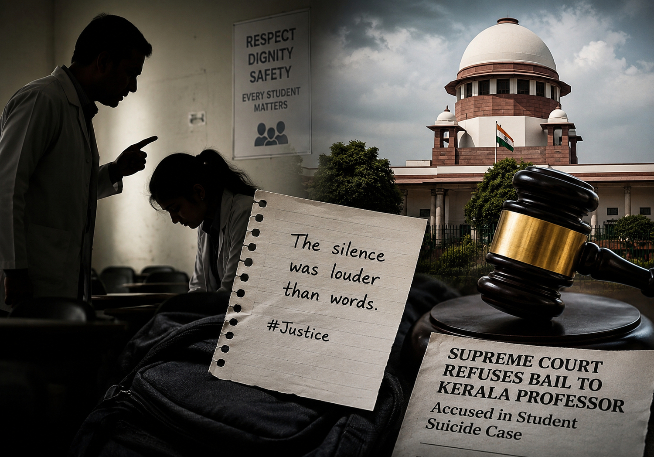
A classroom should be a place where ambition is shaped, not shattered. Yet every so often, an incident forces the law to confront a brutally simple question: when does discipline end and cruelty begin? The Supreme Court’s reported refusal on July 13, 2026 to grant pre-arrest bail to a Kerala medical professor accused of humiliating a student who later died by suicide is one of those moments.
According to PTI’s account of the hearing, the Bench told counsel that “A message has to go that you (teacher) can’t behave in this way with the students,” and added that if a student is insulted in front of classmates, one must consider the ultimate impact of that conduct. The student, Nithin Raj, was a first-year BDS student; the prosecution alleged that he was insulted and intimidated in the classroom, and that he belonged to the Scheduled Caste community. The Court did not decide guilt. It decided something narrower, but still important: that the allegations were serious enough that the accused should not receive the shield of anticipatory bail at this stage.
That distinction matters because Indian criminal law does not punish every harsh word, every rebuke, or every broken interaction. It punishes abetment only when the law can see a real bridge between the accused’s conduct and the suicide. Under the current Bharatiya Nyaya Sanhita, the relevant offence is Section 108, which deals with abetment of suicide and carries imprisonment of up to ten years and a fine; the older IPC equivalent was Section 306. The law’s architecture is deliberate. It does not treat tragedy as proof by itself. It asks for a causal chain, a mental element, and conduct that crosses the line from ordinary conflict into intentional instigation or aiding. That is why this case is important beyond its facts: it asks how far a teacher’s power can go before the law says the classroom became a site of abuse rather than instruction.
The Supreme Court has repeatedly said that abetment to suicide is not made out by vague allegations or by misery in the abstract. In an official judgment uploaded on the Supreme Court website, the Court said that, to sustain Section 306, there must be proof that the accused contributed “by some direct or indirect act,” and that such instigation or incitement must be in close proximity to the suicide and reveal a clear mens rea, or guilty intent. The same judgment explains that, without a positive act of instigating or intentionally aiding suicide, a charge under the section cannot stand. In other words, the law does not criminalise ordinary human friction; it criminalises conduct that is meant to push a vulnerable person toward the edge, or conduct so immediately connected to the death that the law can fairly treat it as part of the same act. That standard is demanding for a reason. Criminal law must be careful when grief is raw and facts are still being tested. But it must be equally careful not to mistake caution for indifference.
This is where the Court’s language in the Kerala professor case lands with unusual force. A teacher does not merely occupy a job title. A teacher occupies a position of trust, authority, and public influence over a young person whose academic future is often still precarious. The law therefore tolerates discipline, correction, and even sternness; it does not tolerate humiliation as a tool of dominance. That is especially true when the alleged conduct takes place in front of peers, because humiliation is rarely private in a classroom. It travels. It becomes memory. It becomes social judgment. It can become shame. And shame, in the presence of a power imbalance, can become something far more dangerous. The Court’s reported remark was not a declaration that every insult causes suicide. It was a warning that when a teacher weaponises status to degrade a student, the law will not treat that as a harmless rough edge of pedagogy.
That warning also aligns with what education law already expects from institutions. The UGC’s 2015 Regulations on sexual harassment in higher educational institutions apply to all higher educational institutions in India and define the campus broadly, including hostels, lecture halls, dining halls, transport, and other associated spaces. The regulations require institutions to publicise anti-harassment norms, train faculty and students, run an Internal Complaints Committee, and act decisively against gender-based violence, harassment, retaliation, and humiliation. They also call for a zero-tolerance campus and make the institution responsible for bringing offenders to book. The Sexual Harassment of Women at Workplace Act, 2013 similarly rests on the constitutional promise of equality and dignity and recognises a right to a safe environment free from sexual harassment. So while the Kerala case is primarily a criminal-law matter, it sits inside a wider legal architecture that already tells educational institutions something plain: campuses are not immunity zones.
That wider architecture matters because this case sits at the intersection of several legal and social anxieties. If the allegations include caste-based insult, the complaint is not only about academic mistreatment. It is about the misuse of institutional power in a setting where humiliation can be sharpened by identity. If the allegations also include sexual harassment, the case would engage not only criminal law but the campus redressal framework that universities are supposed to maintain. And even where the facts do not ultimately prove a sexual offence, the lesson remains the same: a higher educational institution is not just a place that delivers degrees. It is a place that must actively protect the conditions under which a student can learn without fear. That is why a professor’s conduct cannot be judged only by academic authority or disciplinary intent; it must also be judged by the vulnerability of the student on the receiving end.
The tragedy is that Indian law has seen too many such cases to pretend this is a one-off. In a separate line of Supreme Court reasoning, the Court has stressed that “mere humiliation” or harassment, without proof of intentional instigation proximate to the death, does not automatically become abetment. That is an important safeguard against overcriminalisation. The law cannot collapse every painful interaction into a suicide offence, or every bad teacher into a murderer by proxy. The prosecution still has to prove the link. But the existence of that safeguard should not be used to erase the moral reality that repeated humiliation by an authority figure can be corrosive, especially for young people who cannot simply walk away from the person grading them, certifying them, or controlling their academic fate. The legal test is strict, but the human setting is fragile. Courts should keep both truths in view.
That is why the bail stage is not a technical sideshow. Anticipatory bail asks whether the accused deserves pre-arrest protection before the facts have been tested in the ordinary course. In a case like this, granting that protection too casually can feel, to the victim’s family and to students watching from the sidelines, like the system has already decided who matters more: the accused’s convenience or the victim’s dignity. Denying bail, on the other hand, does not determine guilt. It says only that the allegations, the context, and the seriousness of the social harm are enough to justify a more cautious approach. This is especially so where the alleged conduct took place in the open, before classmates, because public humiliation is not only a private wrong. It is a disciplinary signal sent to an entire student body. The Court’s reported line that “A message has to go” was therefore not just about one professor. It was about the kind of campus culture the legal system is prepared to tolerate.
There is, of course, a counterpoint that must be faced honestly. Universities are not supposed to become places where every uncomfortable exchange is criminalised, and teachers are not supposed to live under the fear that any strict correction may later be recast as abetment. That concern is real. It is also why the Supreme Court’s own jurisprudence insists on proximity, intent, and a clear act of instigation or aid. Fair trial rights matter. The presumption of innocence matters. The risk of turning moral outrage into a substitute for proof matters. But those protections are meant to prevent injustice, not to create a zone of professional impunity. A teacher can insist on discipline without belittling a student. A professor can correct failure without assaulting dignity. The law is not asking educators to be soft. It is asking them not to be cruel.
The broader comparison with the #MeToo era is revealing. #MeToo did not merely expand public conversation about sexual misconduct; it forced institutions to ask whether they had made reporting too difficult, power too concentrated, and accountability too optional. The legal response in India was not to abandon due process, but to build a parallel framework: the POSH Act for workplaces and the UGC regulations for higher educational institutions, both grounded in dignity, safety, and institutional duty. That framework is important here because it shows how the law increasingly treats harassment as a systems problem, not merely a personality flaw. One abusive encounter may be prosecuted as a crime. A tolerated culture of humiliation is a governance failure. And when that failure occurs in education, the damage spreads beyond one student because the classroom teaches by example. If students watch a teacher degrade someone with no consequences, they learn that hierarchy is a licence, not a responsibility.
That is also why the phrase “duty of care” should not be left to the language of civil liability alone. In an educational setting, duty of care is the moral and administrative counterpart of the criminal law’s concern with abetment. Institutions are expected to create reporting mechanisms, train staff, prevent retaliation, and intervene before harm escalates. The UGC regulations make that obligation explicit by demanding campus-wide sensitisation and a zero-tolerance policy. The law may ultimately ask whether one person’s conduct crossed the criminal threshold. But the deeper question is whether the institution saw danger brewing and did nothing. Many student tragedies begin long before the final act. They begin with a joke that went too far, a complaint dismissed as oversensitivity, a humiliation normalised as discipline, and a system that mistakes silence for stability.
Nelson Mandela once said, “Education is the most powerful weapon which you can use to change the world.” That line is often repeated because it sounds inspiring, but it also contains a warning: education is powerful enough to build futures, and powerful enough to destroy confidence when it is misused. A campus should therefore be a place where authority enlarges possibility, not crushes it. The Kerala case is not only about whether one professor should get bail or whether one prosecution will succeed. It is about whether India is finally ready to say, with legal seriousness, that the authority to teach never includes the right to humiliate, and that a student’s life cannot be treated as collateral damage in the name of discipline. If this order does anything useful, it should force every institution to re-examine its own culture before the next tragedy arrives.