
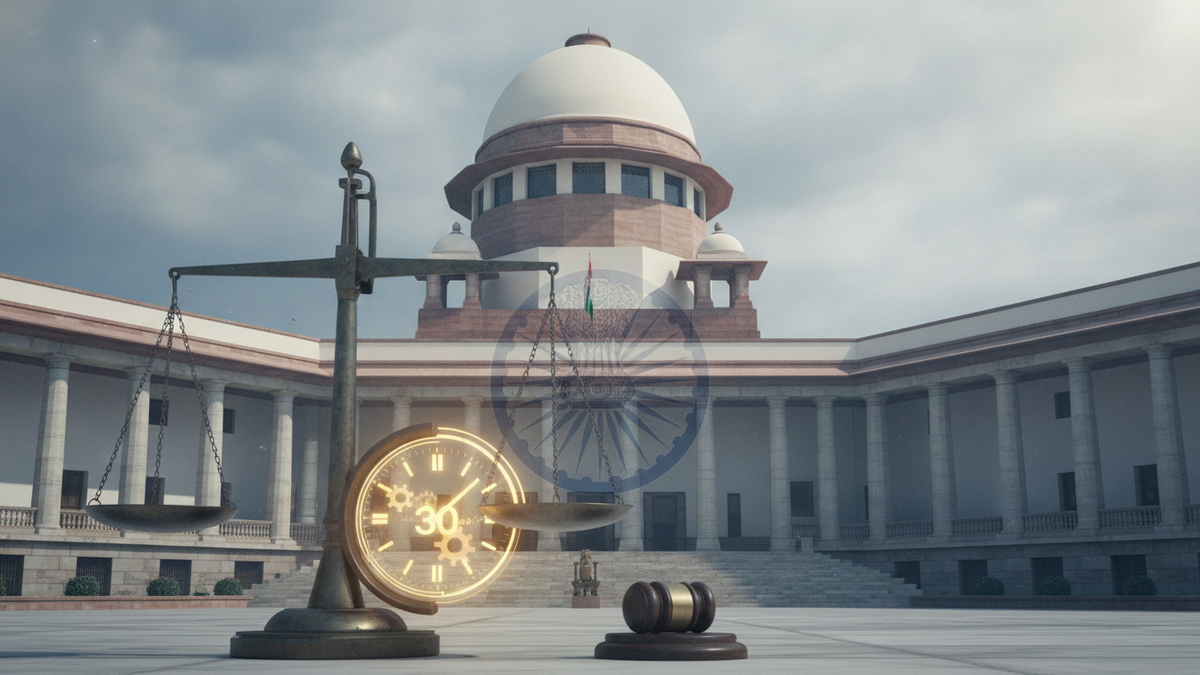
India’s district and subordinate judiciary — the tens of thousands of judicial officers who decide the overwhelming majority of the country’s cases — has no permanent, independent body to fix their pay. On September 12, 2026, the Supreme Court took up a plea asking it to create one: a standing National Judicial Pay Commission (NJPC), reconstituted every ten years, so that judges’ salaries, allowances, pensions and service conditions never again go a decade or more without review.
A bench of Chief Justice of India Surya Kant, Justice Joymalya Bagchi and Justice V. Mohana issued notice to the Union of India and the states in Maharashtra State Judges Association v. Union of India and Others, and posted the matter for October 14, 2026. The petition, filed through Advocate-on-Record Dilip Annasaheb Taur with Senior Advocate B.H. Marlapalle appearing for the petitioner, is narrow in its legal theory but wide in its practical stakes: it asks the Court to convert a decades-old constitutional principle — that judicial pay must be insulated from the executive — into a permanent institutional mechanism, rather than a one-off commission set up whenever the judiciary complains loudly enough.
Why Judicial Pay Has Its Own Constitutional History
Judges’ salaries in India are not fixed by the same process that fixes pay for the rest of the civil service. That separation is not an accident of drafting — it is the direct result of Supreme Court litigation stretching back over three decades.
In All India Judges’ Association v. Union of India, (1993) 4 SCC 288, the Court held that the pay and service conditions of the subordinate judiciary could not simply be left to state governments or clubbed with general Pay Commissions meant for administrative staff. The Court reasoned that a judge who depends on the executive for a raise cannot be fully independent of the executive, and directed the Union to set up a dedicated commission to recommend uniform pay scales for judicial officers nationwide.
That direction produced the First National Judicial Pay Commission, popularly called the Shetty Commission, constituted in March 1996 under Justice K.J. Shetty. It submitted its report in November 1999, and the Supreme Court accepted its recommendations — with modifications — in 2002, directing every state to implement them.
No second commission followed automatically. It took another round of litigation, and a fresh Supreme Court order dated May 9, 2017, to constitute the Second National Judicial Pay Commission (SNJPC) under Justice P.V. Reddi, with former judge and senior advocate R. Basant as member. The SNJPC’s report — running to hundreds of pages — went to revising pay scales, allowances, and pension formulas for the subordinate judiciary, and its rollout was still being supervised by the Supreme Court in All India Judges Association v. Union of India well into 2023, including orders granting states extensions to clear arrears.
The pattern across both commissions is the same: a Pay Commission is created only after the judiciary petitions the Supreme Court, years pass before it is constituted and reports, and years more before states actually pay up. The Maharashtra State Judges Association’s petition targets exactly that gap — asking for a standing body so the next revision does not require another writ petition and another decade of waiting.
The Immediate Trigger: the 8th Central Pay Commission
The petition is not purely aspirational — it responds to a specific, live problem. On November 3, 2025, the Union government’s resolution constituting the 8th Central Pay Commission (8th CPC) included Clause 2(a)(ix), bringing subordinate judicial officers serving in Union Territories within that Commission’s terms of reference.
The Maharashtra State Judges Association argues this directly contradicts the 1993 ruling’s core holding: that judicial service conditions must never be tied to, or reviewed alongside, those of the executive and administrative services. Folding UT judicial officers into a general Central Pay Commission — the same body that reviews pay for central government employees — reintroduces precisely the link the Supreme Court severed in 1993, even if the 8th CPC’s own resolution carries a caveat requiring it to respect that separation in principle.
The petitioners also point to a practical inequity: judicial officers in Union Territories could see their pay determined on a different cycle and methodology than their counterparts in the states, undermining the uniformity in judicial pay scales that both earlier commissions were set up to achieve.
What the Petition Asks the Court to Do
Beyond challenging Clause 2(a)(ix), the writ petition — registered as W.P.(C) No. 650/2026 — seeks:
A Standing Commission, Not a One-Time Fix
A National Judicial Pay Commission constituted as a permanent, recurring institution — reconstituted at fixed intervals (the petition suggests roughly once a decade) — to review pay, allowances, perquisites, pension and post-retirement benefits for judges of the Supreme Court, all 25 High Courts, and the district and subordinate judiciary across every state and Union Territory.
A Defined Implementation Timeline
Unlike the Shetty and Reddi Commissions, whose recommendations took years to be implemented (and are, in the Reddi Commission’s case, still being enforced through Supreme Court supervision), the petition asks for a fixed timeline — reportedly around three months — for the Union and states to act once a future commission reports.
Interim Relief Pending the Commission
As an interim measure, the Association has asked for salary revision for sitting Supreme Court and High Court judges effective January 1, 2026, to align with the 8th CPC’s implementation timeline for central government employees — so that constitutional-court judges are not left waiting behind a fresh commission process that could itself take years to conclude.
The Court’s Order and What Happens Next
The bench’s September 12 order is procedurally modest — notice to the Centre and the states, with the matter listed for October 14, 2026. No interim relief has been granted yet, and the Court has not expressed a view on the merits of either the permanent-commission demand or the 8th CPC challenge.
That said, the framing of the plea — resting squarely on the 1993 and subsequent All India Judges Association line of cases — gives it a well-established doctrinal anchor. The central question the Court will eventually have to answer is not whether judicial pay must be independent of executive pay-fixing (that much has been settled since 1993), but whether the Constitution, or the Supreme Court’s own prior directions, require that independence to be institutionalised as a permanent commission rather than repeatedly re-litigated.
Practical Implications
For the tens of thousands of judicial officers in the district and subordinate courts — the level at which the vast majority of India’s civil and criminal cases are actually tried — this litigation matters more than its procedural posture suggests. Two Pay Commissions in three decades, each requiring fresh Supreme Court intervention to be constituted and years of supervision to be implemented, has meant long stretches where judicial pay simply falls behind inflation and comparable government revisions. A standing commission, reconstituted automatically, would remove that dependency on litigation.
For Union Territory judicial officers specifically, the outcome will decide which body reviews their pay going forward — the 8th CPC, alongside central government employees, or a judicial pay commission applying the uniform-scale principles the Supreme Court laid down for the rest of the subordinate judiciary.
For practitioners and constitutional law observers, the case is also a fresh test of how far the judiciary is willing to go in insulating itself institutionally, at a time when Article 142 powers, judicial appointments, and the separation of powers are already under active public debate. The October 14 hearing, and the Centre’s response to notice, will be the first indicator of how seriously the government intends to contest the core demand for a permanent commission.
Frequently Asked Questions
What is a National Judicial Pay Commission?
It is a body, distinct from the general Pay Commissions that review civil service salaries, tasked specifically with recommending pay, allowances, pensions and service conditions for judges of the Supreme Court, High Courts, and the district and subordinate judiciary. India has had two so far — the Shetty Commission (1996) and the Reddi Commission (2017) — both created only after Supreme Court directions, not as permanent institutions.
Why can’t judicial pay just be decided by the Central Pay Commission like other government employees?
The Supreme Court held in All India Judges’ Association v. Union of India (1993) that judicial officers must not have their pay tied to or reviewed alongside executive/administrative staff, because that link could compromise judicial independence. This is why judicial pay commissions have historically been set up as separate, judiciary-specific exercises rather than folded into the general Central Pay Commission process.
What does the 8th Central Pay Commission have to do with this case?
The 8th CPC’s November 3, 2025 constituting resolution includes subordinate judicial officers serving in Union Territories within its scope. The petitioners argue this reintroduces the very link between judicial and executive pay-fixing that the 1993 judgment prohibited, and creates inconsistency with how judicial officers in the states are treated.
Has the Supreme Court granted any interim relief yet?
No. As of the September 12, 2026 order, the Court has only issued notice to the Union and state governments and listed the matter for October 14, 2026. The interim relief sought — revising judges’ salaries from January 1, 2026 — has not yet been granted or rejected.
Who filed this petition and why?
The Maharashtra State Judges Association, representing serving judicial officers, filed the writ petition through Advocate-on-Record Dilip Annasaheb Taur, with Senior Advocate B.H. Marlapalle appearing. Judges’ associations have historically been the primary petitioners driving judicial pay litigation in India, including both the 1993 and 2017 rounds that produced the first two commissions.
Does this affect High Court and Supreme Court judges too, or only subordinate court judges?
The petition’s core relief — a standing National Judicial Pay Commission — covers judges at every level, including the Supreme Court and all 25 High Courts. However, the immediate trigger (the 8th CPC’s Clause 2(a)(ix)) specifically concerns subordinate judicial officers in Union Territories; High Court and Supreme Court judges’ pay is fixed separately by Parliament under distinct statutes.
Sources
- LiveLaw: Supreme Court Seeks Response Of Centre, States On Plea Seeking National Judicial Pay Commission For Judges - Primary report on the September 12, 2026 order, bench composition, and petition details.
- The Tribune: SC notice to Centre on plea seeking Commission to review judges’ pay, service conditions - Corroborating report confirming notice issuance and next hearing date.
- LawChakra: Supreme Court Issues Notice On Plea For National Judicial Pay Commission, Challenge To 8th CPC Mandate Over UT Judicial Officers - Details on the 8th CPC clause being challenged and interim relief sought.
- Department of Justice, Government of India: First National Judicial Pay Commission - Official background on the Shetty Commission’s constitution and mandate.
- Second National Judicial Pay Commission Report (Government of India) - Official report of the Reddi Commission, confirming its constitution and members.
- Indian Kanoon: All India Judges’ Association And Others v. Union Of India And Others (24 August 1993) - Full text of the founding 1993 judgment on judicial pay independence.
- Indian Kanoon: All India Judges Association vs Union Of India (19 May 2023) - Supreme Court’s continuing supervision of Second National Judicial Pay Commission implementation.
- LiveLaw: Pay Hike For Judicial Officers: Supreme Court Agrees To Grant Extension For States Which Sought Time For Compliance - Illustrates the implementation delays that preceded this petition.