
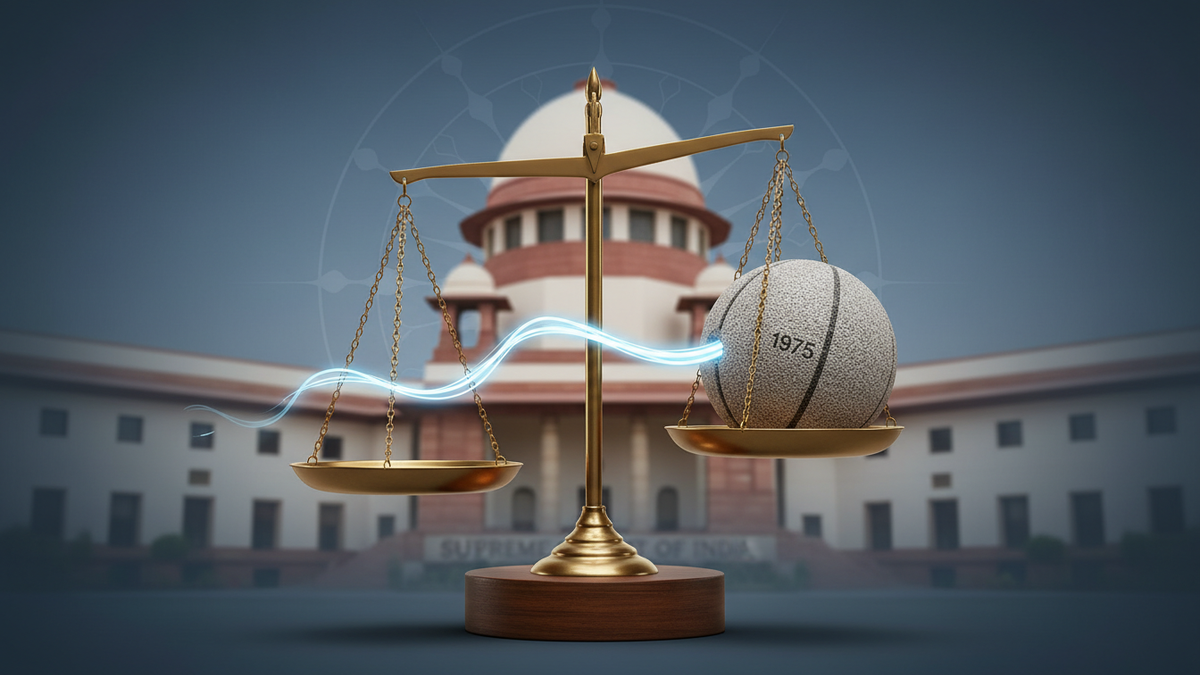
On August 17, 2026, a three-judge Bench of the Supreme Court led by Chief Justice of India Surya Kant dismissed a writ petition asking the Election Commission of India (ECI) to abandon 2002 as the base year for the Special Intensive Revision (SIR) of Sikkim’s electoral rolls, and to use 1993 instead. The petitioner, the NGO Sikkimese Mulniwasi Surakacha Sangh, argued that Sikkim’s unusual constitutional history — it became India’s 22nd state only in 1975, under the special protections of Article 371F — meant its SIR should not be bound by the same national timeline the ECI applied to every other state.
The Bench, which also included Justices Joymalya Bagchi and V Mohana, was unmoved. “The goal post cannot be shifted in the middle of the exercise. 2002 has been kept as the base year for the entire country,” the Court said, according to Business Standard. On its face, this is a narrow order in one state’s revision exercise. In substance, it is the second time in three months that the Supreme Court has been asked to carve an exception into the SIR framework — and the second time it has refused, reinforcing a doctrine of national uniformity that will shape every future SIR the ECI runs.
What Was Actually Being Contested
Sikkim’s SIR follows the same template the ECI used for Bihar in 2025: house-to-house enumeration, a draft roll, a window for claims and objections, and a final published roll. Enumeration in Sikkim began on May 30, 2026, the draft roll was published on July 5, the claims-and-objections window closed on August 4, and the final roll is due on September 6, 2026.
The dispute was over the “base year” — the earlier electoral roll treated as presumptive proof of a voter’s eligibility, so that anyone already on it does not need to re-prove citizenship from scratch. For Bihar, the ECI used 2003. For the nationwide SIR rollout, including Sikkim, it fixed 2002.
The petitioner’s objection was specific to Sikkim: the NGO argued that the demographic data recorded in the 2002 roll does not accurately reflect the state’s genuine “Mulniwasi” (indigenous) population, and that 1993 — closer to the aftermath of Sikkim’s 1975 merger and the cut-off used to determine “Sikkim Subject” status under the old Sikkim Subjects Regulation, 1961 — would produce a cleaner baseline. Article 371F itself preserves special rights (including land ownership and state employment protections) for those descended from persons registered as Sikkim Subjects before the merger, so the argument was not frivolous on its face: it drew on a genuine constitutional peculiarity of the state.
The Court’s Reasoning
The Bench rejected the plea on two grounds that are worth separating, because they do different jobs.
First, a procedural ground: the SIR exercise was already underway, built around 2002 as the base year, and changing that baseline mid-course would disrupt an exercise that had already reached the claims-and-objections stage. Courts are traditionally reluctant to let litigation reset the clock on an administrative process once it is in motion, particularly one with a statutory deadline.
Second, and more significant for future cases, a substantive ground: uniformity itself was treated as a value. The Court noted that voters who were on the 2002 roll had gone on to vote in subsequent Sikkim elections without incident — meaning the roll had already functioned as a reliable record of the franchise for over two decades. Combined with the point that 2002 is “the base year for the entire country,” the order reads as an endorsement of a single national template over a state-specific one, even where the state in question has a documented constitutional basis (Article 371F) for being treated differently on other questions, like land rights and public employment.
The Court did leave the petitioner a door: it noted no ground was made out to interfere with the ECI’s decision through this petition, but the NGO remains free to raise its specific grievances about the roll’s accuracy directly with the Election Commission through the ordinary claims-and-objections process, rather than through a writ petition asking for the base year itself to be re-fixed.
Reading This Against the Bihar SIR Precedent
This order does not arrive in a vacuum. It follows the Supreme Court’s May 27, 2026 judgment in Association for Democratic Reforms v. Election Commission of India, delivered by a Bench of Chief Justice Surya Kant and Justice Joymalya Bagchi, which upheld the ECI’s power under Article 324 and Section 21 of the Representation of the People Act, 1950 to conduct the Bihar SIR, and accepted the Commission’s choice of 2003 as that state’s base year. That judgment applied a proportionality-style review — asking whether the SIR pursued a legitimate purpose and whether its procedural safeguards (notice, hearing, appeal, legal aid) were adequate — rather than simply deferring to the ECI on every point. Importantly, the Court in the Bihar case also held that Article 324 and Article 327 are “not competing sources of power”: the Commission’s constitutional authority over elections is real, but it operates within, not above, the statutory framework Parliament has enacted, chiefly the Representation of the People Act, 1950.
The Sikkim order fits inside that same architecture rather than expanding it. The base year itself — 2002 nationally, 2003 for Bihar specifically — was treated in both cases as falling within the ECI’s administrative discretion, the kind of technical, evidentiary choice courts are reluctant to second-guess absent a showing of arbitrariness or bad faith. What Sikkim adds is a clean answer to a question Bihar left open: can a state’s own special constitutional status be used to demand a different base year than the national one? For now, the answer is no, unless the challenger can show the fixed base year is itself unreasonable or discriminatory — a showing broad demographic disagreement, without more, did not meet.
Why the Article 371F Argument Did Not Land
It is worth being precise about why invoking Sikkim’s special constitutional status did not help the petitioner here. Article 371F protects specific, defined categories of rights for people who trace their status to the pre-merger Sikkim Subjects Regulation — principally land ownership and access to state government jobs and Assembly seats reserved for Sikkimese people. It was not designed as, and the Court did not treat it as, a general license to depart from the uniform election-administration rules Parliament and the ECI apply nationwide under Article 324 and the Representation of the People Act. Special status on one axis of governance (property and public employment) does not automatically translate into special treatment on another (the mechanics of an electoral roll revision), and the Bench’s order effectively confirms that these are separate constitutional questions that must be argued separately, with their own evidentiary basis.
Practical Implications
For Indian legal professionals, the order sharpens the emerging SIR jurisprudence in a specific way: challenges to how a state’s SIR is conducted (documentation, verification timelines, procedural safeguards) remain live and have succeeded in the past, but challenges to the base year itself, where it has been fixed as part of a uniform national policy, face a high bar. Practitioners advising clients or organisations planning to challenge an SIR exercise elsewhere should focus arguments on procedural fairness and evidentiary standards within the existing framework, rather than seeking to relitigate the choice of base year through a writ petition, unless they can marshal specific evidence that the fixed year is itself unreasonable, arbitrary, or discriminatory as applied.
For citizens, particularly in Sikkim, the practical takeaway is narrower but concrete: the 2002 roll remains the reference point for the ongoing revision, the final roll is due September 6, 2026, and anyone with a specific grievance about an entry, omission, or documentation requirement should raise it through the ECI’s claims-and-objections process rather than waiting for a fresh round of litigation to reopen the base year question. As SIR exercises roll out to more states, this order is a signal that the space for procedural objections remains open even as the space for structural, base-year objections has narrowed further.
Frequently Asked Questions
What is the Special Intensive Revision (SIR), and how is it different from a routine roll revision?
The SIR is a more intensive, house-to-house verification of electoral rolls than the annual “summary revision” the ECI ordinarily conducts. It involves fresh enumeration, a documentary basis for anyone not on a specified earlier “base year” roll, and a formal claims-and-objections process before a final roll is published.
What did the Supreme Court actually decide on August 17, 2026?
It dismissed a PIL by the NGO Sikkimese Mulniwasi Surakacha Sangh seeking to replace 2002 with 1993 as the base year for Sikkim’s SIR, holding that 2002 is the uniform base year applied nationally and that changing it midway through the exercise was not warranted.
Does this mean the Election Commission’s SIR decisions can never be challenged in court?
No. Courts have entertained and partly upheld challenges concerning procedural safeguards, documentation burdens, and specific implementation issues, as in the Bihar SIR litigation. What this order narrows is the ability to challenge the choice of base year itself once it has been fixed as part of a uniform, nationwide policy, absent a strong showing that the choice is arbitrary or discriminatory.
How does Article 371F relate to this case, and why didn’t it help the petitioners?
Article 371F gives Sikkim distinct constitutional protections tied to pre-1975 “Sikkim Subject” status, mainly around land ownership and public employment. The Court did not treat this as extending to a right to a different electoral-roll base year, since electoral administration is governed uniformly under Article 324 and the Representation of the People Act rather than under Sikkim’s special provisions.
What happens next for people in Sikkim who believe the 2002 roll is inaccurate for their situation?
The Court left open the ordinary route: individuals or the NGO can raise specific errors, omissions, or eligibility disputes directly with the Election Commission through the claims-and-objections process before the final roll is published on September 6, 2026.
Is the 2002 base year the same one used in Bihar’s SIR?
No. Bihar’s SIR used 2003 as its base year, reflecting the state’s last intensive revision at that time. Sikkim and the rest of the country’s SIR rollout use 2002. Both, however, were upheld by the Supreme Court as within the ECI’s administrative discretion.
Sources
- Sikkim SIR: Supreme Court dismisses plea questioning 2002 electoral roll as baseline - Bar & Bench - Reporting on the August 17, 2026 order, bench composition, and petitioner’s arguments.
- SC refuses to alter ECI’s decision to keep 2002 base year for Sikkim SIR - Business Standard - Direct quote from the Bench on the “goal post” reasoning and case outcome.
- Supreme Court Upholds 2002 Sikkim Electoral Roll Base Year For SIR - Outlook India - Additional detail on the SIR timeline in Sikkim.
- SC refuses to interfere with ECI’s 2002 SIR base year in Sikkim - Siasat - Confirms enumeration and draft-roll dates for the Sikkim SIR.
- Challenge to the ECI’s Revision of Electoral Rolls in Bihar - Supreme Court Observer - Case tracker confirming the May 27, 2026 judgment date, bench composition, and holdings on Article 324 and Section 21 of the Representation of the People Act, 1950.
- Case Summary: Association for Democratic Reforms & Ors. v. Election Commission of India & Ors. (2026) - Legal Bites - Summary of the Bihar SIR judgment’s proportionality analysis and standard of review.
- Supreme Court Upholds Bihar Electoral Roll Revision, Backs EC’s Power to Conduct SIR - Outlook India - Additional reporting on the Bihar SIR judgment for context.
- Article 371F: Special Provisions with Respect to the State of Sikkim - Constitution of India - Text and explanation of Sikkim’s special constitutional provisions and their scope.
- Article 371F: Special Provisions with Respect to the State of Sikkim - LawBhoomi - Background on Sikkim Subject Regulation, 1961 and the 1975 merger context.