
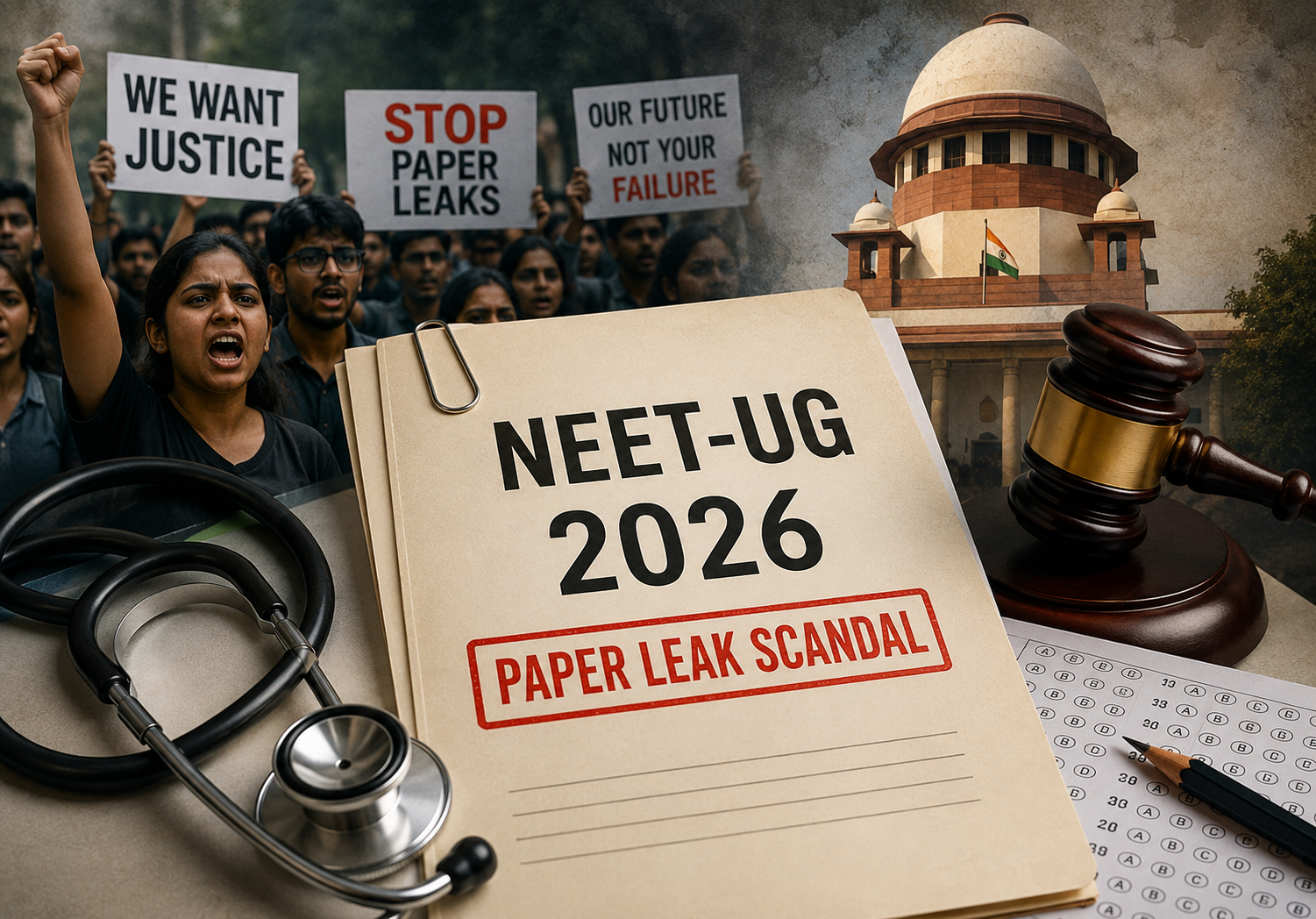
The future of nearly 2.2 million young people changed in a matter of hours. Not because they failed an examination, but because the examination itself failed them. When the National Testing Agency cancelled the 2026 NEET-UG examination after allegations of a widespread paper leak and ordered a nationwide re-test, it did far more than reset an exam calendar. It reopened one of the most difficult constitutional questions in public administration: what should the law do when the State cannot guarantee fairness? The answer is not as straightforward as many would like. A fresh examination may appear to be the cleanest solution, but for every candidate who welcomed a second opportunity, another saw months of disciplined preparation, emotional exhaustion, financial sacrifice and earned merit thrown into uncertainty.
The legal battle that has since unfolded before the Supreme Court is therefore about much more than a competitive examination. It is about trust in public institutions, equality before the law, and whether administrative convenience can ever outweigh individual justice. The Court’s decision to continue hearing multiple petitions challenging different aspects of the controversy, including challenges to the nationwide re-test and broader concerns over examination governance, shows that the legal questions remain very much alive even after the examination has been conducted.
Competitive examinations occupy a unique place in India’s constitutional imagination. They are not merely tests of knowledge. They are gateways to social mobility. For millions of students from villages, small towns and middle-class households, NEET represents the possibility of transforming an entire family’s future. A medical seat is not simply an educational opportunity; it is often viewed as the culmination of years of sacrifice by parents who borrow money for coaching, relocate cities, or postpone retirement to support a child’s ambition. When the integrity of such an examination collapses, the damage extends beyond leaked question papers. It shakes public confidence in one of the few systems that promises advancement through merit.
It is worth remembering that this is not the first time India has confronted an examination scandal. From recruitment examinations for government jobs to university entrance tests, paper leaks have become disturbingly familiar. Yet the scale of NEET makes it fundamentally different. A localised irregularity affecting a few hundred candidates can often be investigated without disturbing the entire process. An examination involving over twenty lakh aspirants across the country presents an entirely different challenge. Every legal remedy inevitably creates new victims. If the examination is allowed to stand despite evidence of widespread compromise, honest candidates may lose faith in merit. If the entire examination is cancelled, honest candidates are punished alongside the guilty. The law therefore finds itself choosing between competing forms of injustice rather than between right and wrong.
That dilemma explains why the petitions before the Supreme Court have attracted so much attention. Former senior public health official Dr. Mangala Kohli challenged the decision to cancel the examination nationwide, arguing that lakhs of bona fide candidates should not bear the consequences of failures committed by a relatively small number of wrongdoers. Other petitions questioned the conduct of the National Testing Agency, while public interest litigation sought broader reforms in examination security and accountability. The Court has repeatedly emphasised that these matters involve issues extending beyond one examination cycle and therefore deserve careful judicial consideration rather than hurried orders.
The central legal question is deceptively simple: when is it lawful to cancel an examination in its entirety? Indian constitutional law offers no automatic formula. Administrative authorities possess discretion to preserve the integrity of public examinations, but that discretion is constrained by constitutional guarantees of equality, fairness and reasonableness under Articles 14 and 21. Every administrative decision affecting fundamental rights must satisfy the test of proportionality. In other words, the government must demonstrate that its chosen response was necessary, rational and the least restrictive option available.
This principle becomes particularly significant in mass examination scandals. **If investigators can identify those who obtained leaked papers and isolate their benefits, then punishing the entire candidate population may appear excessive. **Conversely, if the leak has spread so widely that separating genuine candidates from beneficiaries becomes impossible, a complete re-examination may become the only constitutionally defensible solution. This is not merely a matter of educational policy. It reflects one of the oldest principles of public law: State action must be proportionate to the problem it seeks to solve.
The Supreme Court itself confronted similar questions during the 2024 NEET litigation, where it identified the critical considerations that continue to influence examination disputes: whether the breach affected the examination systemically, whether the integrity of the process was fundamentally compromised, and whether beneficiaries could realistically be segregated from innocent candidates. Those principles remain highly relevant as the 2026 controversy unfolds because they provide a structured legal framework, rather than allowing administrative decisions to depend solely on public pressure or political optics.
**The emotional dimension of this debate, however, cannot be ignored. **Critics of the nationwide re-test argue that cancelling an examination effectively treats every candidate as a suspect.
*Imagine a student from a remote district who spent two years preparing honestly, travelled hundreds of kilometres to reach the examination centre, completed the paper fairly, and returned home believing the ordeal was over. Weeks later, the State announces that the examination no longer counts. Nothing about that student’s conduct has changed. *
Yet the consequences are devastating. Additional preparation, renewed anxiety, altered admission schedules, financial costs and psychological exhaustion become unavoidable. In effect, the honest candidate pays twice for a crime committed by someone else.
**Supporters of the re-test respond with equal force. **They argue that once the sanctity of a national examination is compromised, allowing its results to stand permanently damages public confidence. Every successful candidate would forever face suspicion, regardless of individual innocence. Future employers, institutions and society itself might question whether merit or malpractice determined outcomes. In that sense, the re-test protects honest students by restoring legitimacy to their eventual success. It is an uncomfortable truth that fairness sometimes requires imposing burdens on innocent people to preserve confidence in the system as a whole.
Neither side is entirely wrong. That is precisely why judicial intervention becomes so important. Courts are uniquely positioned to examine evidence, evaluate competing constitutional interests and ensure that executive decisions are supported by objective reasoning rather than administrative expediency. Judicial review does not require judges to manage examinations themselves. It requires them to ask whether those entrusted with conducting examinations have acted lawfully, rationally and proportionately.
The controversy also raises uncomfortable questions about the National Testing Agency itself. Established to professionalise entrance examinations and improve consistency, the NTA has gradually become one of the country’s most consequential public institutions. Every year, millions of candidates depend upon its ability to conduct secure, transparent and reliable assessments. Such enormous responsibility necessarily demands equally rigorous accountability. Administrative agencies exercising wide powers cannot seek public trust merely through assurances. They must earn it through demonstrable competence, transparent decision-making and effective crisis management.
The affidavits filed before the Supreme Court suggest that enhanced security measures, greater government oversight and structural reforms were introduced before the re-test. The NTA informed the Court that recommendations of a high-powered committee had been implemented to strengthen examination security, while the government defended the decision to conduct a fresh nationwide examination. Those measures may well represent meaningful progress. Yet reforms implemented after a crisis cannot erase legitimate questions about how the original breach occurred or whether institutional safeguards were adequate in the first place.
One of the most striking aspects of the litigation has been the Court’s repeated emphasis on accountability rather than symbolism. During hearings, the Bench reportedly observed that **merely reacting to scandals would never solve the underlying problem unless genuine responsibility was fixed. **That observation deserves attention because India’s response to examination leaks has too often focused on immediate damage control rather than systemic prevention. Arrests are announced, committees are formed and security protocols are revised, but public memory fades until the next scandal emerges.
There is a famous observation by the American jurist Louis Brandeis: *“Sunlight is said to be the best of disinfectants.” *His point was not simply about transparency but about institutional integrity. Public institutions become stronger when they operate under constant scrutiny rather than episodic outrage. Examination authorities should therefore welcome independent audits, transparent investigations and judicial oversight instead of viewing them as threats. Confidence in merit cannot survive behind closed doors.
The criminal dimension of the controversy deserves equal attention. A paper leak is not merely an administrative lapse. It represents **organised fraud with potentially enormous financial incentives. **Leaking confidential examination material often involves networks spanning printing facilities, logistics providers, examination centres, intermediaries and beneficiaries. Investigating such conspiracies requires sophisticated forensic techniques, digital evidence preservation, financial tracking and coordinated policing across multiple jurisdictions. Convicting a few individuals after every scandal is insufficient if the underlying criminal ecosystem remains intact.
Equally important is the question of compensation and legal remedies available to affected students. Indian law does not presently offer a comprehensive statutory framework governing mass examination failures. Students can challenge administrative decisions through writ petitions under Article 226 before High Courts or Article 32 before the Supreme Court when constitutional rights are implicated. They may also seek directions for independent investigations, transparent disclosure of examination processes or reconsideration of disputed administrative actions. Whether consumer protection law applies remains contested, but the broader principle is unmistakable: candidates are not powerless when public authorities fail to discharge their legal obligations.
International experience offers useful perspective. In the United States, professional licensing examinations such as the bar examination have occasionally faced allegations involving technical failures, scoring errors or isolated security concerns. Courts generally avoid ordering wholesale cancellation unless the integrity of the examination has been fundamentally compromised. Instead, remedies are often tailored to the specific defect, balancing fairness with institutional stability. Several European jurisdictions similarly favour targeted corrective measures wherever beneficiaries can be reliably identified. These examples demonstrate that mature legal systems increasingly prefer precision over blanket responses whenever reliable evidence permits.
India’s challenge, however, is uniquely complex because of the extraordinary scale of its entrance examinations. Administering a nationwide paper-based examination for millions of candidates inevitably creates logistical vulnerabilities that smaller jurisdictions do not face. This reality strengthens rather than weakens the case for technological innovation. Secure digital testing, encrypted paper distribution, biometric verification, AI-assisted anomaly detection, real-time surveillance and independent auditing should no longer be viewed as optional improvements. They represent essential investments in constitutional governance because educational opportunity itself increasingly depends upon them.
Some critics argue that courts should avoid interfering in academic matters altogether. According to this view, judges lack technical expertise and excessive judicial intervention risks delaying admissions and disrupting educational calendars. There is merit in judicial restraint. Courts cannot become examination boards. Yet restraint must never become abdication. When administrative decisions affect fundamental rights, judicial review is not interference but constitutional duty. The question is not whether courts should supervise educational policy. The question is whether they should ensure that constitutional guarantees continue to apply even inside examination halls. The answer must surely be yes.
Perhaps the greatest casualty of repeated examination scandals is not an admission cycle but public trust itself. Every leak encourages a dangerous belief that success depends less on preparation than on access, influence or corruption. That perception harms honest students far more deeply than any individual examination cancellation because it erodes belief in meritocracy. Once young citizens conclude that institutions reward manipulation instead of effort, democratic legitimacy itself begins to weaken. As former President Dr. A.P.J. Abdul Kalam often reminded young Indians, “Dream, dream, dream. Dreams transform into thoughts and thoughts result in action.” But dreams require institutions worthy of trust. Merit cannot flourish where fairness appears negotiable.
The NEET litigation therefore represents an opportunity as much as a crisis. The Supreme Court has before it an occasion to articulate enduring constitutional principles governing examination integrity, administrative accountability and proportionality in mass educational disputes. Whatever the eventual outcome of individual petitions, the Court’s reasoning will likely shape how future governments respond to examination scandals involving millions of students.
The larger lesson extends well beyond NEET. Every public institution ultimately depends upon legitimacy rather than authority. Authority can compel compliance, but only legitimacy inspires confidence. Students do not merely appear for examinations because the law requires them to do so. They participate because they believe the process will judge them fairly. The moment that belief disappears, even perfectly organised examinations lose their moral authority.
The tragedy of the 2026 NEET controversy is not simply that a question paper was allegedly leaked. It is that millions of young people found themselves asking whether the system protecting their future deserved their trust. Courts can answer legal questions. Governments can introduce reforms. Investigators can prosecute offenders.
But restoring confidence requires something deeper: a sustained commitment to treating examination integrity as a constitutional obligation rather than an administrative challenge. When the State invites citizens to compete on merit, it enters into a promise as solemn as any legal contract. Breaking that promise injures not only individual careers but the idea that fairness remains possible in a democracy. The law can punish those who steal examination papers. Its greater responsibility is to ensure that it never becomes acceptable for honest students to pay the price.