
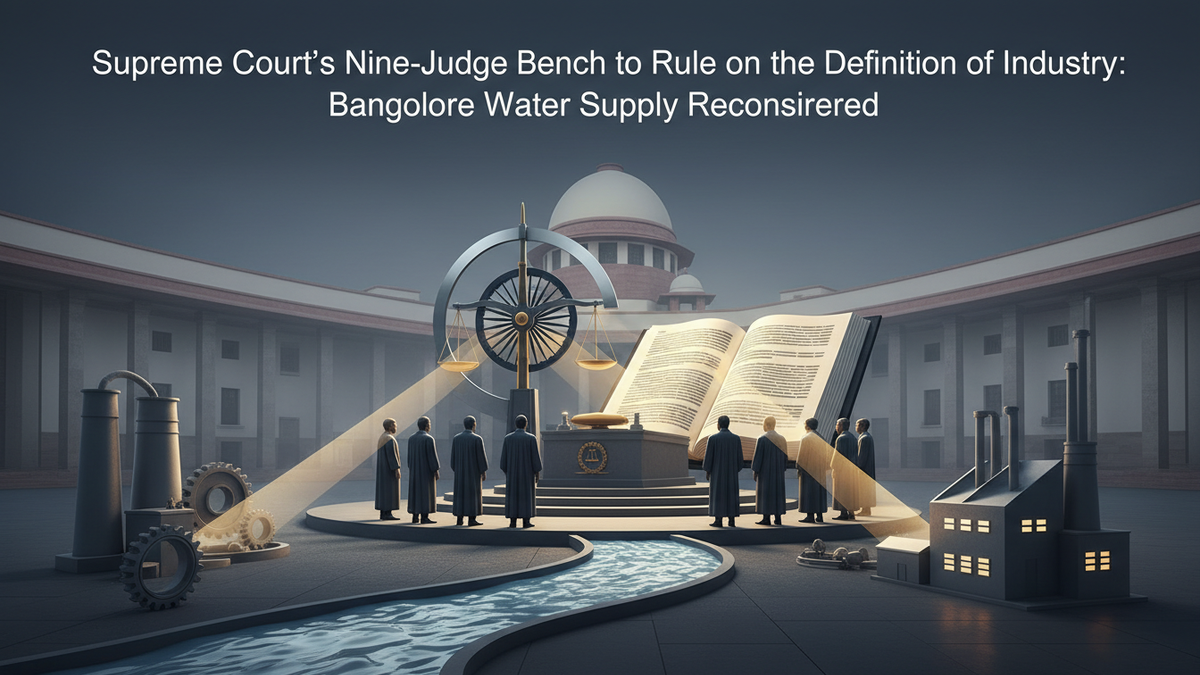
Later today, a nine-judge Constitution Bench of the Supreme Court of India — a bench size the Court has convened only a few dozen times in its 75-year history — is scheduled to pronounce its verdict on one of the oldest unresolved puzzles in Indian employment law: what, exactly, is an “industry”?
The question sounds almost trivially simple. The answer determines whether millions of people working in hospitals, universities, government welfare departments, charitable trusts, and municipal utilities can invoke the protective machinery of the Industrial Disputes Act, 1947 — reinstatement on illegal dismissal, compulsory conciliation, adjudication before a Labour Court or Industrial Tribunal, and the tribunal’s unique power under Section 11A to reduce a punishment that even a writ court cannot touch. Answered one way, that machinery stays open to them. Answered the other way, it does not.
A 48-Year-Old Precedent on the Table
The case that reaches judgment today, State of Uttar Pradesh v. Jai Bir Singh, is on paper a modest dispute over whether “social forestry” — a state government afforestation scheme — counts as an industry. But it has become the vehicle for something much larger: a reconsideration of the seven-judge bench decision in Bangalore Water-Supply & Sewerage Board v. R. Rajappa, decided on 21 February 1978 by a bench that included Justice V.R. Krishna Iyer.
Bangalore Water Supply gave Section 2(j) of the Industrial Disputes Act its famous “triple test”: an activity is an industry if there is (i) systematic activity, (ii) organised through cooperation between employer and employee, (iii) for the production or distribution of goods or services calculated to satisfy human wants or wishes — profit motive or not. Applied literally, that test swept hospitals, educational institutions, clubs, and charitable bodies into the definition, alongside factories and commercial establishments.
The consequences played out unevenly in the decades since. A three-judge bench in Chief Conservator of Forests v. Jagannath Maruti Kondhare ((1996) 2 SCC 293, decided December 1995) held that a state government’s social forestry scheme was itself an industry. In State of Gujarat v. Pratamsingh Narsinh Parmar ((2001) 9 SCC 713), the Court took a more cautious line on similar facts, holding that the burden lies on whoever asserts an establishment is an “industry” to plead and prove the facts supporting that claim — an approach state governments have since leaned on to resist industry status for their departments. Parliament tried to legislate its way out with a 1982 amendment listing exclusions — hospitals, educational institutions, khadi and village industries among them — but that amendment was never notified and remains a dead letter to this day.
By May 2005, a five-judge Constitution Bench hearing the Jai Bir Singh reference itself described the position as a “docket explosion” and referred Bangalore Water Supply’s correctness to a larger bench. It sat unresolved for over a decade until, in January 2017, a seven-judge bench led by then Chief Justice T.S. Thakur ordered the reference placed before a nine-judge bench in view of the “serious and wide-ranging implications” of the issue — the bench that finally heard arguments between 17 and 19 March 2026 and is set to rule today, 20 August 2026.
The Bench and What It Is Actually Deciding
The nine judges are Chief Justice Surya Kant and Justices B.V. Nagarathna, P.S. Narasimha, Dipankar Datta, Ujjal Bhuyan, Satish Chandra Sharma, Joymalya Bagchi, Alok Aradhe and Vipul M. Pancholi. Per the February 2026 order constituting the bench, three questions sit at the centre of the reference: whether Section 2(j) ought to be read restrictively rather than expansively; whether the Bangalore Water Supply majority was truly as unanimous and settled as it is usually described; and whether a narrower reading better serves the statute’s purpose of harmonious industrial relations. Woven through all three is the unresolved status of “sovereign functions,” the “dominant nature” test for composite government departments, and how much interpretive weight the still-unnotified 1982 amendment and the Industrial Relations Code, 2020 should carry.
What Each Side Told the Court
The three days of hearings in March produced a genuine split down predictable but sharply argued lines.
For the Union of India, Attorney General R. Venkataramani did not ask the Court to discard the triple test outright, but argued it had been “indiscriminately applied leading to over-inclusion,” and pressed for a wide reading of “sovereign functions” — drawing on the unenforced 1982 amendment’s own list of exclusions: defence, research, atomic energy, space, agriculture, hospitals and education. Uttar Pradesh’s Additional Solicitor General K.M. Nataraj argued that Parliament’s later legislative choices — the 1982 amendment and the 2020 Code — should be read as interpretive guides showing an intent to cut back Bangalore Water Supply, urging an “Indian context” rather than an imported colonial-era understanding. Senior Advocate Shekhar Naphade, for Maharashtra, went further, urging the Court to abandon the triple test altogether for an “essential governmental function arising out of a statutory obligation” test — under which roads, irrigation, and welfare schemes like social forestry could never be industries, since they carry no commercial character.
On the other side, Senior Advocates Indira Jaising and C.U. Singh defended the status quo. Jaising argued that the Act is beneficial legislation to be read broadly — citing Workmen of Firestone Tyre & Rubber Co. of India v. Management (1976) for Section 11A’s power to let a Labour Court or Tribunal reappraise a disciplinary inquiry and reconsider a dismissal on its merits, a power an ordinary civil or writ court lacks — and that even a genuinely sovereign or spiritual activity’s “severable” labour component should stay within the Act rather than be excluded wholesale, since protections should not weaken merely because the state privatises an activity or calls it a “mission” rather than a commercial undertaking. Singh, for the National Trade Union Initiative, argued Bangalore Water Supply had if anything already narrowed sovereign immunity by carving out limited exceptions — unlike the earlier Safdarjung line, which wrongly assumed blanket immunity for government bodies — and pointed to the Act’s own “safety valves,” provisions letting government exempt specific establishments in the public interest, as reducing the need for judicial intervention; he also flagged that any reinterpretation might have to apply only prospectively, given how many cases rest on the existing framework. Justice Dipankar Datta pressed both sides on whether individual disputes should drive a definitional test at all, rather than a structural analysis of the entity itself.
Why the Outcome Matters Either Way
The practical stakes are not abstract. If the nine judges retain something close to the Bangalore Water Supply formulation, government welfare schemes, aided educational institutions, charitable hospitals, and municipal bodies stay exposed to adjudication before Industrial Tribunals and Labour Courts, with the reinstatement and compensation remedies that follow. If the Court instead narrows the definition around “sovereign functions” or a “principal activity” commercial-character test, a correspondingly large number of employees currently covered — many with no other statutory recourse for a dismissal dispute, since general contract and service-law remedies rarely offer reinstatement — would need to fall back on ordinary civil litigation or writ jurisdiction, both slower and without the specialised, worker-protective procedure the 1947 Act was built around.
There is also an institutional dimension. Nine-judge benches sit only for questions the Court considers important or unsettled enough to warrant a bench larger than the usual five-judge Constitution Bench — itself a marker of how unresolved this area has remained despite 48 years of supposedly binding precedent. Whatever the Court holds today will bind every High Court and Industrial Tribunal in the country, and will also shape how the definitional provisions of the still not fully implemented Industrial Relations Code, 2020 are eventually read once notified.
Practical Implications for Employers, Employees, and Practitioners
Employers structured as trusts, societies, or government-linked welfare bodies should treat today’s ruling as the first thing to check before assuming — or denying — coverage under the Act. Employees in hospitals, educational trusts, and welfare-scheme establishments whose “workman” status has so far rested on Bangalore Water Supply’s wide reading may find the judgment either confirms their existing remedies or pushes them toward civil suits or writ petitions instead. Practitioners with live disputes pending before Labour Courts and Tribunals on the strength of the 1978 test should expect this judgment to be cited immediately, and should read the full text for any transitional directions, since a bench revisiting a near-five-decade-old precedent typically addresses how far back its ruling reaches.
Frequently Asked Questions
What is the “industry” definition case actually about?
It is a Supreme Court reference, State of Uttar Pradesh v. Jai Bir Singh, asking a nine-judge Constitution Bench whether the wide “triple test” for what counts as an “industry” under Section 2(j) of the Industrial Disputes Act, 1947 — laid down in the 1978 case of Bangalore Water-Supply & Sewerage Board v. R. Rajappa — is still good law, or should be read more narrowly to exclude sovereign and welfare functions of the state.
Why does it matter if an activity is called an “industry” under this Act?
Only employees of an “industry” who qualify as “workmen” can access the Act’s machinery — conciliation, adjudication before Labour Courts and Industrial Tribunals, and remedies like reinstatement and the tribunal’s Section 11A power to reduce a disciplinary punishment. Employees outside that definition must rely on ordinary civil or writ remedies, which typically do not include reinstatement.
Who is on the nine-judge bench, and when did it hear arguments?
Chief Justice Surya Kant and Justices B.V. Nagarathna, P.S. Narasimha, Dipankar Datta, Ujjal Bhuyan, Satish Chandra Sharma, Joymalya Bagchi, Alok Aradhe and Vipul M. Pancholi heard final arguments over three days, from 17 to 19 March 2026, and reserved judgment on 19 March 2026.
Does this affect the Industrial Relations Code, 2020?
The 2020 Code, meant to eventually replace the 1947 Act, has not yet been fully notified and brought into force. Both sides urged the bench to treat its definitional choices as relevant to interpreting the current Act, so today’s reasoning is likely to also shape how the Code is read once it takes effect.
What happened to the 1982 amendment that tried to narrow this definition?
Parliament amended Section 2(j) in 1982 to list exclusions — including hospitals, educational institutions, and khadi and village industries — from the definition of “industry.” That amendment was never notified and has never come into force, leaving the original 1978 Bangalore Water Supply test as the operative law even today.
Will this ruling reopen settled cases decided under the old test?
That depends on what the bench says about the judgment’s prospective or retrospective effect, typically addressed explicitly in a ruling that overturns or narrows a decades-old precedent relied on in tens of thousands of cases. Practitioners with pending matters should read the full judgment for any such directions once released.
Sources
- Supreme Court 9-Judge Bench Reserves Judgment On Correctness Of ‘Industry’ Definition In Bangalore Water Supply Board Case - LiveLaw - Report on the bench composition and reservation of judgment on 19 March 2026.
- Supreme Court 9-Judge Bench To Pronounce Judgment Tomorrow On Correctness Of ‘Industry’ Definition - LiveLaw - Confirms the 20 August 2026 pronouncement date and case background.
- Definition of “Industry” - Case Page - Supreme Court Observer - Full procedural history from the 1978 judgment through the 2026 nine-judge bench constitution and referral questions.
- Definition of “Industry” | Day 1: Union and states recommend tests to determine “sovereign functions” - Supreme Court Observer - Arguments of the Attorney General and state governments.
- Definition of “Industry” | Day 2: Respondents defend wide interpretation of “industry” - Supreme Court Observer - Arguments of Senior Advocates Indira Jaising and C.U. Singh for the workers’ side.
- Definition of “Industry” | Bangalore Water Supply and Sewerage Board v R. Rajappa | Judgement Summary - Supreme Court Observer - Summary of the original 1978 seven-judge bench ruling and the triple test.
- SC’s 9-Judge Bench To Pronounce Verdict On Aug 20 On Definition Of ‘Industry’ - Free Press Journal - Confirms the scheduled pronouncement date and the questions before the bench.
- Industrial Disputes Act, 1947 - India Code - Full text of the statute, including Section 2(j) and Section 11A.