
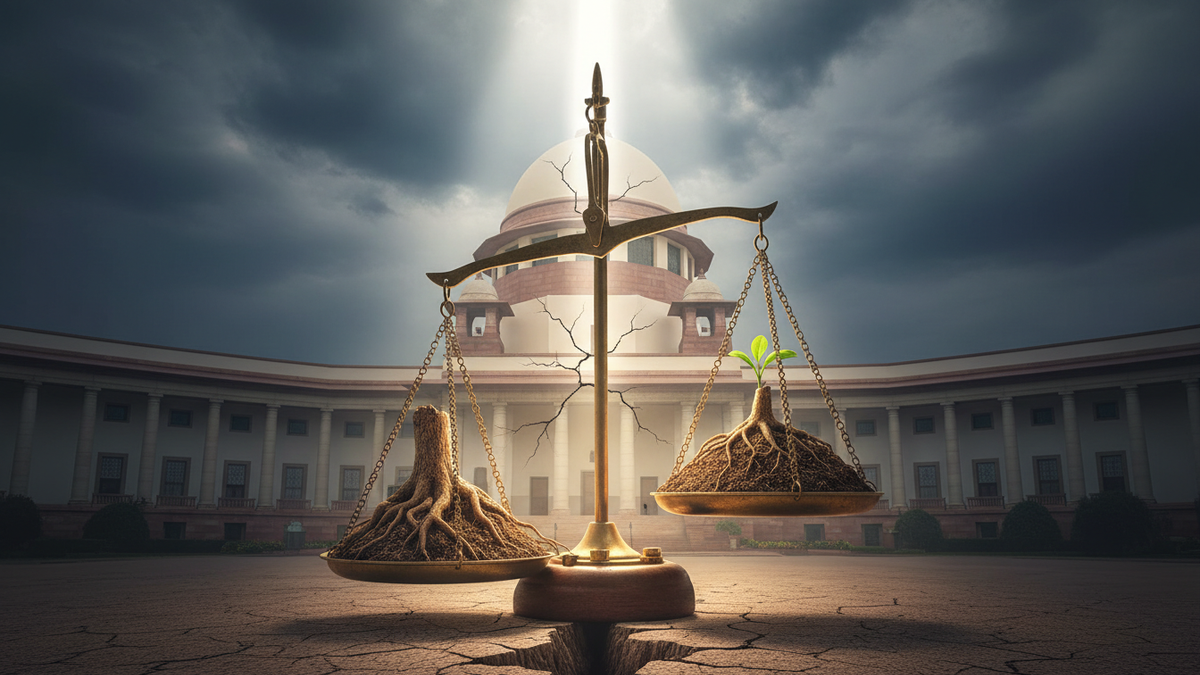
On September 21, 2026, the Supreme Court did something Indian courts do rarely and only in the most extreme circumstances: it threw out three separate police investigations — by the local police, the Karnataka CID, and the CBI — into a single crime, and ordered a brand-new Special Investigation Team to start over from scratch. The crime was the rape and murder of a 17-year-old college student, Sowjanya, near Dharmasthala in Karnataka’s Dakshina Kannada district, in October 2012. Thirteen years, three investigating agencies, and one acquittal later, a Bench of Justice Sanjay Kumar and Justice Sanjeev Sachdeva held that the way the case had been investigated “shocks the very conscience of the court” (Verdictum).
The judgment, Kusumavati Gowda v. The Government of Karnataka, 2026 INSC 1030, matters well beyond one Karnataka town. It is a rare, closely reasoned demonstration of when — and how — a constitutional court can order a fresh criminal investigation years after a trial has already ended in acquittal, without reopening the door to prosecuting the person who was acquitted. For a country where investigative failure is a chronic complaint in high-profile cases, the ruling is a template.
What Happened in 2012 — and What Went Wrong Since
Sowjanya, a second-year pre-university student, went missing on October 9, 2012, while returning home from her college near Dharmasthala. Her body was found the next day in bushes in the Mannasanka area, bearing injuries consistent with rape and strangulation (LiveLaw). The case, and the temple town where it happened, quickly became the subject of intense public and political attention.
Three Agencies, One Suspect, No Conviction
Investigation of the crime passed successively from the Belthangady Police to the Karnataka CID and finally to the CBI. Each of the three, in turn, settled on the same man: Santhosh Rao, an itinerant labourer apprehended near the town’s Bahubali statue two days after the crime (India Legal). Throughout, the victim’s family and local residents maintained that three other, more influential local individuals were the real culprits, and that Rao had been made a scapegoat. The Sessions Court trying the CBI’s case ultimately acquitted Rao in June 2023, finding the prosecution’s evidence insufficient to connect him to the crime — and, in doing so, effectively confirmed that thirteen years of investigation by three agencies had failed to produce a case that could stand up in court.
The Fight for Reinvestigation
Sowjanya’s father then petitioned the Karnataka High Court for a fresh, independent investigation, arguing that crucial evidence had been ignored or destroyed and that the real perpetrators had never been seriously investigated. The High Court dismissed that petition in 2024 — even as it recorded serious misgivings about how the case had been handled. Her father died during the subsequent proceedings, and it was Sowjanya’s mother, Kusumavati Gowda, who carried the appeal to the Supreme Court (Verdictum).
The Supreme Court’s Order
“Shocks the Very Conscience of the Court”
Setting aside the High Court’s refusal, the Bench did not mince words. It observed that “the manner in which the various investigating agencies conducted the investigation and gathered and evaluated the evidence shocks the very conscience of the court,” and that “the person who was prosecuted was held to be incapable of committing the offence” — meaning the investigation itself had, by its own results, proved that it had pursued the wrong track for over a decade (Verdictum). The Court added that “society would be failing in its duty if it does not provide justice to the victim of such a heinous crime by bringing the real culprits to book,” framing the case squarely as one about the state’s obligation to victims, not merely to the accused (Verdictum).
Shielding the Acquitted Accused Under Article 20(2)
A crucial — and legally delicate — part of the order is what it does not do. Santhosh Rao was acquitted, and Article 20(2) of the Constitution, reinforced by Section 300 of the Code of Criminal Procedure, bars a second prosecution for the same offence once a person has been tried and acquitted or convicted. The Bench was careful to hold that the fresh SIT probe cannot be used to re-prosecute Rao: the double jeopardy protection stands undisturbed even as the investigation into who actually committed the crime reopens (Verdictum). In effect, the Court separated two questions that had been conflated for thirteen years: whether Rao was guilty (settled, by acquittal) and whether anyone else was ever properly investigated (never answered).
A Clean-Slate SIT, With a Deadline
The Court directed the Karnataka government to constitute a new Special Investigation Team headed by a senior police officer and staffed with investigators “conversant with modern investigative technology.” Pointedly, it barred any officer who had been part of the Belthangady Police, CID, or CBI investigations from joining the new team — a direct response to the pattern of each successive agency simply inheriting, rather than testing, the assumptions of the one before it (Free Press Journal). The SIT has three months to complete the investigation and file its report before the competent court (LiveLaw).
When Can Courts Order a Fresh Investigation?
For practitioners, the more durable value of this judgment lies in how it slots into — and extends — a settled but narrow doctrine.
Fresh Investigation, Further Investigation, and Reinvestigation Are Not Interchangeable
In Vinay Tyagi v. Irshad Ali (2013), the Supreme Court drew a sharp line between “further investigation” under Section 173(8) CrPC — which any investigating agency, or a magistrate, can order to supplement an existing chargesheet — and “fresh,” “de novo,” or “reinvestigation,” which starts the process over and can be ordered only by a superior court in exceptional circumstances, using its constitutional powers under Articles 226 or 32 (Indian Kanoon). The Court held that a magistrate has no power to order the latter; only a High Court or the Supreme Court does, and only where the earlier investigation is shown to be so unfair, tainted, or incompetent that the ordinary remedy of further investigation will not cure it.
Pooja Pal v. Union of India (2016), arising from the 2005 murder of Raju Pal, a sitting Uttar Pradesh MLA, in an alleged politically engineered assassination, extended that logic to hold that a constitutional court retains the power to order a fresh, de novo probe by an independent agency such as the CBI where the record shows the earlier investigation was neither effective, purposeful, nor fair — even where that means displacing an investigation already carried through to a chargesheet or trial (Indian Kanoon). Kusumavati Gowda applies that same power at what is arguably its outer edge: not merely after a chargesheet, but after a full trial and an acquittal that has already become final for the one person who was tried.
Why This Case Meets the Exceptional Threshold
The doctrine cautions against treating “reinvestigation” as a routine second bite for dissatisfied complainants — courts have repeatedly warned that ordering a fresh probe casts a shadow over the professional competence of the police and must not become the default response to every acquittal. What tipped this case over that threshold, on the Court’s own reasoning, was not merely that Rao was acquitted, but that three successive agencies converged on the same, ultimately unsustainable theory without seriously testing the alternative one the family had pressed for over a decade — a pattern the Bench treated as itself evidence of investigative failure rather than of the case’s actual difficulty.
Practical Implications
For criminal lawyers, the judgment is a fresh, current citation for the narrow but real category of cases where a court will order a de novo probe post-acquittal — useful precisely because such orders remain rare enough that practitioners often struggle to find recent examples with facts this stark. For investigating agencies, it is a pointed reminder that chargesheets built on convergence between successive agencies, rather than independent testing of evidence, invite exactly this kind of judicial intervention. For victims’ families, it affirms that an acquittal of the accused who was prosecuted is not necessarily the end of the road if the underlying investigation itself was never sound — though the three-month timeline the Court has set will be the real test of whether that affirmation translates into an actual, prosecutable case this time.
Frequently Asked Questions
Does this Supreme Court order mean Santhosh Rao will be tried again?
No. Rao’s acquittal stands, and Article 20(2) of the Constitution together with Section 300 CrPC protect him from being tried again for the same offence. The fresh investigation is directed at identifying whether other individuals were responsible, not at reopening the case against him.
What is the difference between “further investigation” and “de novo” or “fresh” investigation?
Further investigation, under Section 173(8) CrPC, supplements an existing investigation and chargesheet, and can be ordered by the investigating agency itself or a magistrate. A fresh, “de novo,” or reinvestigation starts the entire process over and can be ordered only by a High Court or the Supreme Court, exercising constitutional writ jurisdiction, in exceptional cases where the earlier investigation is shown to be fundamentally unfair or incompetent.
Why did it take 13 years to reach this order?
The case moved through three separate investigating agencies (local police, state CID, and CBI), a full criminal trial that ended in the accused’s acquittal in 2023, an unsuccessful reinvestigation petition before the Karnataka High Court in 2024, and finally an appeal to the Supreme Court — each stage adding years before the matter was conclusively addressed.
Who will conduct the new investigation, and by when?
A newly constituted Special Investigation Team, headed by a senior Karnataka police officer and excluding any officer previously involved in the Belthangady Police, CID, or CBI probes, has three months from the date of the order to complete the investigation and file its report before the competent court.
Is this connected to the separate “Dharmasthala mass burial” allegations that have made headlines in 2026?
The two matters concern the same town but are legally distinct. This Supreme Court order relates specifically to the 2012 Sowjanya rape-murder case. The mass-burial allegations, involving a whistleblower’s claims of buried bodies over a longer period, are the subject of a separate SIT investigation and have generated their own, ongoing political and legal controversy in Karnataka.
Can courts order reinvestigation in any case where a family is dissatisfied with an acquittal?
No. Indian courts have consistently held that ordering a de novo investigation is an extraordinary remedy, not a routine one, reserved for cases where the record itself shows the earlier investigation was tainted, incompetent, or designed to protect the real culprits — not merely for cases where the prosecution failed to prove its case at trial.
Sources
- Supreme Court Orders De Novo Probe Into 2012 Dharmasthala Minor’s Rape & Murder Case - Verdictum’s report on the judgment, with direct quotes and case citation details.
- Supreme Court Orders Fresh Probe In 2012 Dharmasthala Rape-Murder Case After Acquittal Of Sole Accused - LiveLaw’s coverage confirming bench composition, procedural history, and the three-month SIT deadline.
- Dharmasthala rape-murder: Supreme Court orders fresh SIT probe, says earlier investigation deeply offends the court’s sense of justice - India Legal’s report on the SIT composition and exclusion of prior investigators.
- Dharmasthala Rape-Murder Case: Supreme Court Orders Fresh Probe Into Sowjanya’s 2012 Death, Sets 3-Month Deadline - Free Press Journal’s account of the SIT mandate and timeline.
- Sowjanya rape-murder case: Supreme Court orders reinvestigation - The News Minute’s background on the victim, the original crime, and the family’s pursuit of the case.
- Vinay Tyagi vs Irshad Ali @ Deepak & Ors, 2013 - The foundational Supreme Court judgment distinguishing further investigation from fresh/de novo investigation.
- Pooja Pal vs Union Of India And Ors, 2016 - The Supreme Court precedent permitting post-trial reinvestigation where the original probe is shown to shield the real culprits.
- Dharmasthala case: ‘We are for justice,’ says Shivakumar - Deccan Herald’s report on the Karnataka government’s response and the case’s political context.