
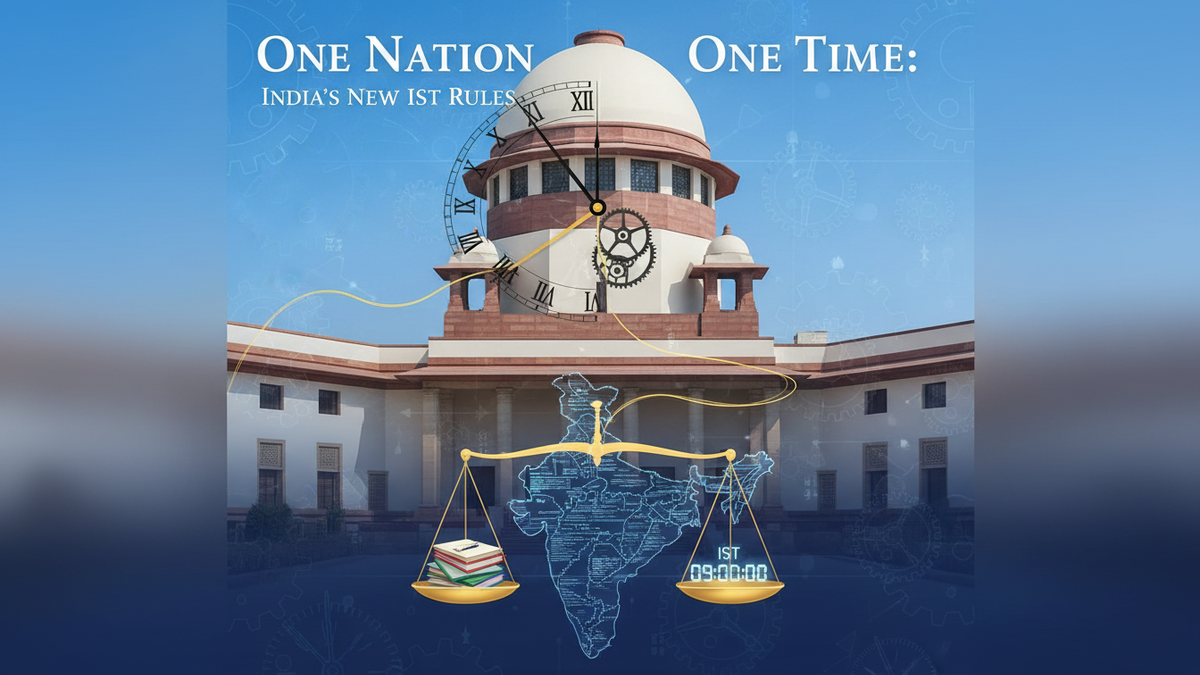
On August 27, 2026, the Department of Consumer Affairs, acting under Section 52 of the Legal Metrology Act, 2009, notified the Legal Metrology (Indian Standard Time) Rules, 2026 — a set of rules that, on their face, read like a technical standard for clocks. In substance, they do something far more consequential for lawyers, compliance officers, and litigators: they make Indian Standard Time (IST) the single, legally mandatory time reference for every legal, administrative, commercial, and official purpose in the country, and they bar the use of any alternative time reference unless the Rules expressly permit it, as the Department has confirmed. The Rules were published in the Official Gazette on August 29, 2026, and will take effect 180 days later — placing the compliance deadline in late February 2027.
This is the “One Nation, One Time” initiative the Ministry has been developing for several years, but its arrival as binding law changes the stakes. A contract’s moment of formation, a court filing’s timestamp, a bank’s transaction record, and a forensic log entered as electronic evidence all depend on “what time it is” being a settled, provable fact. Until now, that fact rested on convention. It is now a matter of statute.
What the Rules Actually Require
A Single Legal Clock
The core mandate is straightforward: IST — defined as UTC(NPLI) + 5 hours 30 minutes, generated and maintained by the CSIR-National Physical Laboratory (CSIR-NPL) using an ensemble of atomic clocks traceable to Coordinated Universal Time within nanoseconds — becomes the only time reference that government offices, businesses, financial institutions, and critical infrastructure operators may hold out as authoritative. Telecom networks, digital payment systems, stock exchanges, railways, power grids, and data centres must synchronise their systems to IST using Network Time Protocol (NTP) or Precision Time Protocol (PTP), disseminated through CSIR-NPL, five Regional Reference Standards Laboratories (in Ahmedabad, Bengaluru, Bhubaneswar, Faridabad, and Guwahati), and — notably — India’s own NavIC satellite constellation, an option the Rules add specifically to reduce dependence on foreign satellite-based timing sources like GPS.
The Exemptions
The Rules are not absolute. Scientific research, astronomical work, and navigation may continue to use alternative time scales, but only with prior government approval. Hotels, international organisations, and space centres may display a foreign time zone for operational convenience, provided IST is displayed alongside it as the principal legal reference. Beyond these carve-outs, though, the presumption runs the other way: any use of a non-IST time reference for a legal, administrative, or commercial purpose is presumptively non-compliant. Enforcement sits with the Legal Metrology Department, which can conduct inquiries and impose penalties under the Legal Metrology Act, 2009 for violations identified through periodic audits.
Why This Is Not Just a Metrology Footnote
It would be easy to file this alongside India’s other weights-and-measures rules and move on. That would miss what makes it interesting to a legal audience: the Rules intersect with at least three areas of live legal doctrine that already depend on precise, provable time.
Contract Formation and Electronic Records
Under Section 13 of the Information Technology Act, 2000, the time of dispatch and receipt of an electronic record is not a formality — it fixes when an offer is made, when an acceptance is communicated, and when a contract is formed, with real consequences for revocation and breach. Section 13 ties dispatch to the moment a record “enters a computer resource outside the control of the originator,” and receipt to when it enters the addressee’s designated (or undesignated) computer resource. Both determinations assume a time reference that a court can treat as authoritative. The 2026 Rules now supply that reference as a matter of law rather than commercial convention, which should, in principle, make disputes over “who sent what, when” easier to resolve — but only once businesses actually re-timestamp their systems to the new statutory baseline.
Digital Evidence Under the BSA
Timestamps are equally central to the admissibility of electronic evidence. Section 63 of the Bharatiya Sakshya Adhiniyam, 2023 (the successor to Section 65B of the Indian Evidence Act) requires a certificate authenticating the electronic record produced in court, and courts routinely scrutinise the metadata — including timestamps — of emails, call detail records, CCTV footage, and server logs to establish the sequence of events in both civil and criminal proceedings. A single, legally mandated, nanosecond-traceable IST reference strengthens the evidentiary chain for any record generated after the compliance deadline, giving forensic timestamps a statutory anchor they did not previously have.
Cybersecurity Compliance Under CERT-In
This is not, in fact, the first time Indian law has required clock synchronisation. The Indian Computer Emergency Response Team’s April 2022 Directions, issued under Section 70B(6) of the IT Act, already require “covered entities” to synchronise all ICT system clocks with the NTP servers of the National Informatics Centre or CSIR-NPL, and to retain system logs for 180 days within Indian jurisdiction. The 2026 Rules generalise and elevate that sector-specific cybersecurity obligation into an economy-wide, legally binding time standard — meaning organisations that built CERT-In-compliant logging pipelines around NPL/NIC time servers already have a head start, while those relying on other time sources for their broader operations do not.
The Open Question the Rules Do Not Answer
The blanket prohibition on non-IST time references sits uneasily with a near-universal engineering practice: databases, server logs, and networked systems overwhelmingly store timestamps internally in UTC, converting to local time only when a record is displayed to a user. Read literally, the Rules’ bar on using or recording “any time reference other than IST” could be understood to reach that backend practice; read narrowly, it should only govern the time an entity holds out as its official, displayed reference. The Rules themselves do not resolve which reading applies, and the 180-day window gives regulators time to clarify through guidance before enforcement begins — but until they do, compliance and legal teams building or auditing timestamping systems have a genuine interpretive gap to navigate, not merely a technical one.
Practical Implications
For lawyers, the near-term task is less about the physics of atomic clocks than about auditing where “time” matters in a client’s contracts, evidentiary practices, and compliance posture. Standard-form contracts that reference delivery, notice, or performance deadlines by time zone should be checked against the new IST baseline. Litigators relying on electronic evidence should be prepared to establish, going forward, that a record’s timestamp derives from an IST-traceable source. Compliance teams already meeting CERT-In’s 2022 synchronisation mandate should confirm their NTP infrastructure satisfies the broader 2026 Rules as well, rather than assuming the two frameworks are automatically coextensive. None of this requires panic before February 2027 — but it does require attention now, while the compliance window is still open and before the first enforcement audits begin.
Frequently Asked Questions
When do the Legal Metrology (Indian Standard Time) Rules, 2026 actually take effect?
The Rules were published in the Official Gazette on August 29, 2026 and come into force 180 days later, placing the compliance deadline at approximately the end of February 2027.
Does this mean businesses can no longer use UTC anywhere in their systems?
The Rules bar holding out any time reference other than IST for legal, administrative, or commercial purposes, but they do not explicitly address internal backend storage conventions like UTC timestamps in databases. This is currently an open interpretive question that regulators are expected to clarify before enforcement begins.
What happens if an organisation does not comply?
The Legal Metrology Department can conduct inquiries through periodic audits and impose penalties under the Legal Metrology Act, 2009 for confirmed non-compliance, though the Rules leave the department’s implementing guidance to specify the exact procedure and penalty quantum.
How does this relate to the CERT-In cybersecurity directions from 2022?
CERT-In’s April 2022 Directions already required certain “covered entities” to synchronise ICT system clocks with NPL or NIC time servers as a cybersecurity measure. The 2026 Rules extend a similar synchronisation requirement economy-wide and give it independent statutory force under the Legal Metrology Act, rather than only a cybersecurity-compliance basis.
Why does IST matter for digital evidence in court?
Under the Bharatiya Sakshya Adhiniyam, 2023, electronic records require certification to be admissible, and courts examine metadata — including timestamps — to establish sequence and authenticity. A single, statutorily mandated, atomic-clock-traceable time reference gives those timestamps a firmer evidentiary foundation than reliance on assorted commercial time sources.
Are there any exemptions from the IST mandate?
Yes. Scientific research, astronomical work, and navigation may use alternative time scales with prior government approval, and hotels, international organisations, and space centres may display foreign time zones alongside IST as the principal legal reference.
Sources
- PIB: Legal Metrology (Indian Standard Time) Rules, 2026 Notified - Official government press release announcing the notification.
- The Tribune: ‘One Nation, One Time’: IST to become mandatory time reference from March 2027 - Reporting with Union Minister Pralhad Joshi’s statement and sector coverage.
- The Tribune: ‘One nation, one time’: India moves towards self-reliance in time-keeping - Background on CSIR-NPL’s role and the White Rabbit dissemination network.
- Civilsdaily: Indian Standard Time made the single legal time reference through new Legal Metrology rules - Summary of the notification and prohibition on alternative time references.
- GKToday: Centre Notifies Rules Mandating Indian Standard Time - Coverage of the statutory basis, agencies, and penalty framework.
- Swarajya: Centre Notifies ‘One Nation One Time’ Rules - Detail on exemptions and dissemination infrastructure.
- Legacy IAS Academy: PIB Summaries, September 3, 2026 - Gazette date, RRSL locations, and effective-date computation.
- Information Technology Act, 2000, Section 13 (IndianKanoon) - Statutory text on time and place of dispatch and receipt of electronic records.
- CERT-In Directions under Section 70B(6) of the IT Act, 2000 (April 28, 2022) - Original directions requiring NTP clock synchronisation and 180-day log retention.
- Legal Metrology Act, 2009 (India Code) - Text of the parent statute, including Section 52 rule-making power.