
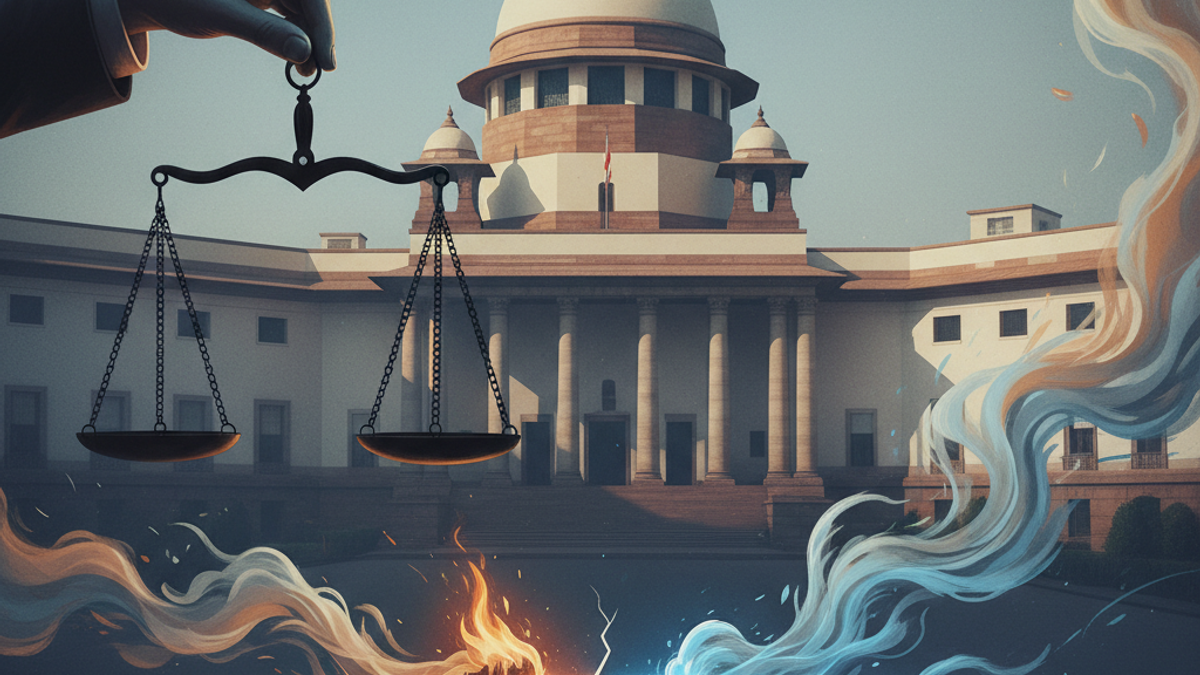
Four lawsuits, one Delhi courtroom corridor, and barely a month between them. Since late July 2026, the Delhi High Court has decided a rapid succession of “personality rights” disputes involving Salman Khan, Physics Wallah founder Alakh Pandey, and actors Janhvi and Khushi Kapoor — and in doing so, it has done more to define the practical boundaries of this still-unlegislated right than the Supreme Court has in two decades of scattered, lower-court skirmishes.
Personality rights — a person’s legal claim over their own name, voice, image, mannerisms and likeness — have no dedicated Indian statute. They have been built almost entirely through interim injunctions in civil suits, borrowing from the tort of passing off, trademark principles, and, increasingly, Article 21 of the Constitution. What makes this month’s cluster of rulings significant is not that the Delhi High Court recognised the right — it has been doing that since at least the ICC Development era — but that it is now, case by case, drawing a line between what the right protects and what it cannot be allowed to swallow: satire, criticism, and ordinary fan commentary.
A Right Built on Precedent, Not Statute
India has no “Personality Rights Act.” What exists is a decade-plus of Delhi High Court orders — mostly ad-interim, ex-parte injunctions granted at the first hearing — that have progressively expanded the list of protectable attributes. In Anil Kapoor v. Simply Life India & Ors., CS(COMM) 652/2023, Justice Prathiba M. Singh restrained the commercial use of the actor’s name, image, voice, and even his catchphrase “Jhakaas,” recognising that a signature phrase delivered in a signature way can itself be a protectable personality attribute. A year earlier, in Amitabh Bachchan v. Rajat Nagi & Ors., Justice Navin Chawla granted similar protection against a fake KBC lottery fraud trading on Bachchan’s name and voice.
From Passing Off to Article 21
What is new in the 2026 cases is the explicit constitutional framing. In the Salman Khan matter, Justice Jyoti Singh held that the right to personality is “an intrinsic facet of Article 21 of the Constitution,” encompassing privacy, dignity and reputation — not merely a commercial or trademark-adjacent interest. That framing matters because it draws a direct line to the Supreme Court’s nine-judge bench ruling in Justice K.S. Puttaswamy v. Union of India, (2017) 10 SCC 1, which located informational and decisional privacy within Article 21’s guarantee of life and personal liberty. Anchoring personality rights to Article 21, rather than to passing-off alone, gives plaintiffs a constitutional — not just proprietary — hook, and gives courts room to weigh the claim against countervailing Article 19(1)(a) free-speech interests rather than treating it as a pure property dispute.
Four Cases, Four Data Points
Salman Khan: The Broadest Order
On July 30, 2026, in Salman Khan v. Ashok Kumar, CS(COMM) 1322 of 2025, Justice Jyoti Singh restrained the makers of a proposed film, “Kala Hiran — The Battle For Legacy,” from exhibiting or disseminating its teaser anywhere — cinemas, OTT, television, print, or social media. Although the film’s protagonist was fictionally named “Ayan Khan,” the teaser’s dialogue invoked Khan’s films Dabangg and Sikandar, referenced Kankani village and the Bishnoi community, and dramatised a courtroom trial mirroring his real, pending blackbuck-poaching case. The court found this “prima facie irreparably and gravely damaging” to Khan’s goodwill, and ordered X, Meta, and Google to pull the relevant URLs within 24 hours if the filmmakers failed to comply.
Alakh Pandey: Protection With an Asterisk for Satire
Days earlier, in Alakh Pandey v. John Doe(s) & Ors., the Physics Wallah founder secured an interim order directing the takedown of content that was vulgar, commercially exploitative, or that impersonated him — including fake profiles, Telegram channels, and AI-manipulated videos and stickers trading on his teaching style and image. But Justice Anup Jairam Bhambhani deliberately carved out one YouTube video calling Pandey “scamwala” for separate, later consideration rather than folding it into the blanket takedown. The court signalled it would examine, in a subsequent hearing reported on August 22, whether personality-rights suits were “increasingly being used to prevent dissemination of information relating to a wrongdoing, or block satire or parody in the name of publicity rights.” Justice Bhambhani’s own words were unambiguous: personality rights, he held, “are not deployed to prevent dissemination of information in relation to wrongdoing; or to extinguish an entire genre of expression including caricature, lampooning or parody.”
Janhvi and Khushi Kapoor: The Narrowest Relief Yet
The clearest illustration of the court drawing a boundary came in Janhvi Kapoor’s suit. The actor’s plea sought a blanket takedown covering 6,884 URLs. Justice Bhambhani refused, holding that “all content could not be treated in the same manner” and that a blanket order was inappropriate without examining each category. He ordered removal of only 552 URLs — those that were “ex facie pornographic or obscene,” directly monetised her persona, or used her name to sell merchandise — while explicitly declining to touch fan pages and general commentary, observing that admiration, criticism and commentary are the ordinary lot of a public figure. In her sister Khushi Kapoor’s parallel suit, Justice Jyoti Singh reached a similarly calibrated order: takedown of obscene material and unauthorised merchandise listings, again without a blanket sweep of fan content.
Why the Line Is Being Drawn Now
Two forces are pushing Delhi High Court judges to formalise this doctrine at speed. First, generative AI has made convincing impersonation — fake videos, cloned voices, fabricated “interviews” — trivial to produce, as the court’s own December 2025 order protecting actor R. Madhavan against fake, AI-generated film trailers and obscene content using his likeness illustrated. Second, plaintiffs’ lawyers have learned that broad, hastily-drafted takedown lists work as a first-mover tactic: file for thousands of URLs, get an ex-parte order before anyone can object, and let platforms sort out the collateral damage. The Kapoor sisters’ cases show judges pushing back on that tactic specifically, insisting that URLs be sorted into defensible categories — pornographic, commercially exploitative, impersonating — rather than nodded through en masse.
The Practical Implications
For litigators, the message from this cluster of orders is procedural as much as substantive: courts are now expecting plaintiffs to categorise the impugned content before filing, rather than dumping an undifferentiated list of thousands of links and asking for everything to go. Suits that distinguish obscene material, commercial exploitation, and impersonation from ordinary fan pages, parody accounts, and critical commentary are far more likely to get fast, comprehensive ad-interim relief; suits that don’t will get partial relief and a lecture on overbreadth, as Janhvi Kapoor’s did.
For platforms — X, Meta, Google, Telegram — the orders reinforce a now-familiar compliance pattern: a short compliance window (typically 24 to 48 hours) to act once a rights-holder identifies infringing URLs, with the court itself stepping in only if the platform or uploader fails to comply.
For ordinary citizens and satirists, Justice Bhambhani’s language is the more important half of this story. A right built to protect a film star’s reputation and a YouTuber’s teaching persona from commercial hijacking cannot, on the same logic, be turned into a tool to erase parody, criticism, or reporting on a public figure’s own conduct — including, pointedly, reporting on a pending criminal case, as in the Salman Khan matter itself. Until Parliament or the Supreme Court steps in with a settled framework, it is this case-by-case sorting exercise, hearing by hearing, that is doing the work of defining where personality rights end and free expression begins.
Frequently Asked Questions
What are “personality rights” in Indian law?
Personality rights are a person’s legal claim to control commercial and reputational use of their name, image, voice, signature phrases, and other distinctive attributes. India has no dedicated statute for them; they are enforced through civil suits combining the common-law tort of passing off, trademark-style reasoning, and, increasingly, Article 21 of the Constitution.
Did the Supreme Court decide any of these personality rights cases?
No. All four 2026 rulings discussed here — involving Salman Khan, Alakh Pandey, Janhvi Kapoor, and Khushi Kapoor — are interim orders of the Delhi High Court. The Supreme Court has not yet laid down a comprehensive framework for personality rights, so High Court interim orders currently do most of the doctrinal work.
Can a personality rights claim be used to stop satire or parody about a celebrity?
According to Justice Anup Jairam Bhambhani’s observations in the Alakh Pandey matter, no — personality rights cannot be deployed to block “an entire genre of expression including caricature, lampooning or parody,” or to suppress information about a person’s own wrongdoing. Courts are actively distinguishing such protected speech from unauthorised commercial exploitation or impersonation.
Why did the court refuse a full takedown in Janhvi Kapoor’s case but grant one in Salman Khan’s?
The two suits sought different things. Janhvi Kapoor’s plea asked for a blanket takedown of 6,884 URLs covering everything from obscene content to ordinary fan pages, which the court found overbroad; it ordered removal of only the 552 URLs that were clearly obscene or commercially exploitative. The Salman Khan order targeted a single, specific film teaser found to be a targeted, commercially exploitative dramatisation of his pending criminal case — a narrower and more clearly infringing target.
What role does Article 21 play in these rulings?
Courts, including in the Salman Khan and Alakh Pandey orders, have described personality rights as “an intrinsic facet of Article 21,” linking them to the right to privacy, dignity and reputation recognised by the Supreme Court’s nine-judge bench in Justice K.S. Puttaswamy v. Union of India (2017). This constitutional framing lets courts weigh personality-rights claims against competing Article 19(1)(a) free-speech interests, rather than treating them purely as commercial property disputes.
What should someone do if they believe their identity is being misused online in India?
The current practice, reflected in these orders, is to file a civil suit (typically before the Delhi High Court, which has developed the most extensive personality-rights jurisprudence) seeking an ad-interim injunction, with a clearly categorised list of infringing URLs — separating obscene, commercially exploitative, and impersonating content from ordinary commentary — to maximise the chance of prompt, comprehensive relief.
Sources
- Delhi High Court orders takedown of “Kala Hiran” teaser over alleged unauthorised use of Salman Khan’s persona - SCC Online Blog report on the Salman Khan interim order, including case citation and directions to platforms.
- Physics Wallah Founder Alakh Pandey Moves Delhi High Court Seeking Protection Of Personality Rights - LiveLaw report on the Alakh Pandey suit and interim takedown order.
- Personality rights cannot be used to stifle freedom of expression, satire: Delhi High Court - Bar & Bench report on Justice Bhambhani’s observations regarding satire and parody in the Alakh Pandey matter.
- Delhi HC refuses blanket takedown of fan pages in Janhvi, Khushi Kapoor personality rights suits - MediaNama’s detailed report on the Kapoor sisters’ cases and the court’s URL-by-URL approach.
- Janhvi Kapoor gets partial relief as Delhi HC orders removal of obscene content, rejects blanket takedown - India TV News report with details of the 552 vs. 6,884 URL breakdown.
- Anil Kapoor vs Simply Life India & Ors on 20 September, 2023 - Indian Kanoon record of the earlier “Jhakaas” personality rights precedent.
- Delhi High Court grants ex-parte ad-interim injunction to Amitabh Bachchan protecting his publicity rights - SCC Online Blog on the 2022 Bachchan precedent.
- Delhi HC grants ad interim injunction protecting R Madhavan’s personality rights - ANI report on the December 2025 precedent addressing AI-generated deepfake misuse of a public figure’s identity.
- Justice K.S.Puttaswamy (Retd) and Anr. vs Union of India and Ors. on 24 August, 2017 - Full text of the nine-judge bench right to privacy judgment underpinning the Article 21 framing used in these orders.