
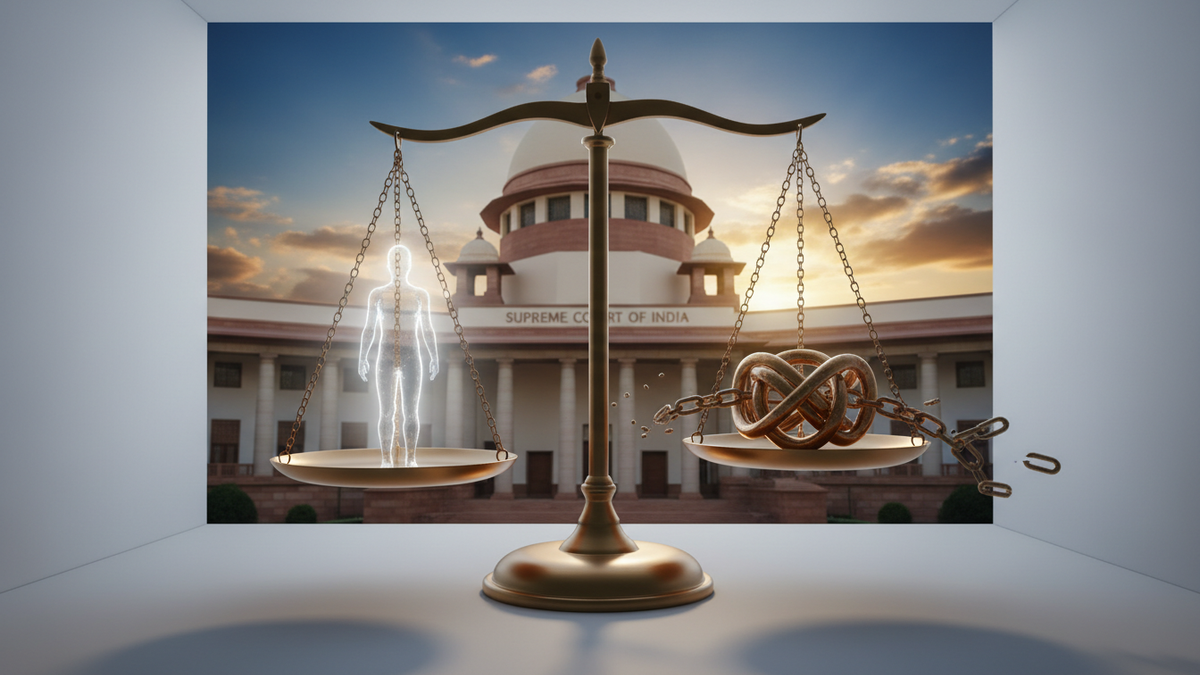
Nine years after the Delhi High Court first split down the middle on whether a husband can be prosecuted for raping his wife, the Supreme Court of India has moved the marital rape exception a decisive step closer to a final answer. On September 9, 2026, a three-judge bench led by Chief Justice of India Surya Kant, sitting with Justices Joymalya Bagchi and V. Mohana, directed that the petitions challenging the exception be listed for final hearing within three weeks, with hearings on Wednesdays and Thursdays — the closest this decade-old challenge has come to a substantive final hearing.
The stakes are considerable. What is under challenge is Exception 2 to Section 375 of the Indian Penal Code, 1860 — carried forward, in near-identical terms, as Exception 2 to Section 63 of the Bharatiya Nyaya Sanhita (BNS), 2023: “sexual intercourse or sexual acts by a man with his own wife, the wife not being under eighteen years of age, is not rape.” Strike it down, and Indian criminal law would for the first time recognise that consent within marriage cannot be presumed. Uphold it, and the position dating to 1860 continues.
How the Case Reached the Supreme Court
The current batch is not a single writ petition but a consolidation of eight connected matters, listed together as Item 108 on the Supreme Court’s board — four arising from the reference made after the Delhi High Court’s split verdict, and three fresh petitions (including one filed in 2026), arriving from two separate tracks.
The Delhi High Court’s 2022 Split Verdict
The first track is a direct appeal from the Delhi High Court’s May 2022 judgment in RIT Foundation v. Union of India (2022 SCC OnLine Del 1404), where a two-judge bench split. Justice Rajiv Shakdher held that the exception violates Article 14 and struck it down; Justice C. Hari Shankar disagreed, reasoning that an “intelligible differentia” separates marital sex from sex between strangers, and that it does not dissolve merely because the act is non-consensual. Because the bench was divided, Justice Shakdher granted leave for a direct appeal to the Supreme Court.
The Karnataka “Marital Rape” Prosecution
The second track began with an actual criminal prosecution. In Hrishikesh Sahoo v. State of Karnataka, a husband facing rape charges under the IPC approached the Karnataka High Court seeking to have the charge quashed by invoking the marital rape exception. On February 23, 2022, Justice M. Nagaprasanna refused, holding that “no exception under law can be so absolute that it becomes a license for the commission of a crime against society.” His Special Leave Petition was admitted, and a bench led by then Chief Justice N.V. Ramana stayed the High Court’s ruling in July 2022 — protecting the accused from prosecution while the constitutional question remains pending.
The two tracks were clubbed; substantive hearings first opened in October 2024 before stalling. September 9 is the case’s most concrete revival since.
What the Court Said on September 9
Two things stand out from the September 9 hearing beyond the scheduling order itself.
First, the bench framed the dispute as two distinct constitutional questions rather than one. As reported, the Court indicated it would examine whether a prosecution for marital rape can be sustained even if the exception survives, and separately, whether the exception itself is constitutionally valid. That matters because it opens the door to a narrower, case-specific ruling — in the Sahoo matter, for instance — even if the bench is unwilling to strike down the exception outright as general law.
Second, the bench signalled real discomfort with the exception’s premise. Justice Joymalya Bagchi is reported to have told the petitioners’ counsel: “We fully appreciate the submission that there is no question of marriage resulting in an extinction of individual autonomy. Point well taken… before a person can be prosecuted, rightly or wrongly, a constitutional court has to render a verdict that the exception is unreasonable or manifestly arbitrary.” That is not a ruling, but it frames the test the bench appears to be applying — Article 14 “manifest arbitrariness” rather than a privacy- or dignity-first standard alone. A full roster of senior counsel — Indira Jaising, Karuna Nundy, Gopal Sankaranarayanan, Colin Gonsalves, and Mahalakshmi Pavani — appeared for the petitioners against Solicitor General Tushar Mehta for the Union; arguments will open with the Karnataka High Court’s SLP before moving to the wider challenge.
The Union’s Position
The Centre’s stance, restated at this hearing, has not shifted from the position it took before the Delhi High Court. The Union government has argued that striking down the exception carries wider social consequences for marriage and calls for a holistic, legislative response rather than judicial intervention — any new criminal liability of this kind, it says, should come from a “suitably tailored” penal framework designed by Parliament, not from judicial reading-down.
Petitioners counter that striking down Exception 2 creates no new offence at all: rape is already defined and punished under Section 63 (and, before it, Section 375), so removing the marital exemption only removes husbands from an immunity against a charge that already exists. The bench was not fully persuaded, however, observing that reading down the exception would still amount to “creation of an offence because the boundaries of culpability are being changed” — suggesting it sees this as more than a mechanical removal of an exemption. How the Court resolves that tension, alongside the Centre’s call for legislative first-mover status, will shape the outcome as much as the constitutional analysis itself.
Why the Age Backdrop Matters
The exception has already been narrowed once by the Supreme Court. In Independent Thought v. Union of India, (2017) 10 SCC 800, the Court held Exception 2 unconstitutional insofar as it excluded marital sex with a wife between 15 and 18 from the definition of rape, aligning it with the POCSO Act’s threshold of 18 regardless of marital status. What remains protected today is intercourse with an adult wife specifically — the narrower, more contested question now before the Court, since it engages autonomy within an ongoing marriage rather than the protection of a minor.
Practical Implications
For litigants with pending complaints or FIRs alleging marital rape, the interim stay in the Sahoo matter means no such trial can conclude until the Supreme Court rules — expect delay, not early relief. For family law and criminal defence practitioners, a final hearing opening in late September or early October 2026 means preparing now: the constitutional arguments on Article 14, privacy, and dignity are settled ground from the Delhi High Court record, but the “two questions” framing suggests the Court may carve a middle path, recognising individual prosecutions without a blanket declaration of unconstitutionality. Civil society stakeholders tracking gender-law reform should also watch whether the Court instead asks Parliament to legislate, which would shift this from a judicial to a legislative timeline entirely.
Conclusion
Nearly a decade after this question first reached a constitutional court, India is close to a definitive answer on whether marriage can shield a husband from a rape charge. The Supreme Court’s own words on September 9 — that marriage cannot mean the “extinction of individual autonomy” — suggest which way the moral weight of the argument is tilting, even as the Union resists a judicial answer to what it calls a legislative question. With final hearings now scheduled, the outcome, whichever way it goes, will be one of the most consequential criminal law rulings India has seen in years.
Frequently Asked Questions
What exactly is the “marital rape exception”?
It is Exception 2 to Section 375 of the Indian Penal Code (carried forward as Exception 2 to Section 63 of the Bharatiya Nyaya Sanhita, 2023), which states that sexual intercourse by a man with his own wife, provided she is not a minor, is not rape — even without her consent.
Has the Supreme Court struck down the marital rape exception?
No. As of September 2026, the Supreme Court has only directed that the case be listed for final hearing within three weeks. No verdict on the constitutional validity of the exception has been delivered.
Why are there two separate cases before the Supreme Court on this issue?
One is a direct appeal from the Delhi High Court’s 2022 split verdict in RIT Foundation v. Union of India, where two judges disagreed on the exception’s constitutionality. The other arises from a Karnataka High Court ruling in Hrishikesh Sahoo v. State of Karnataka, which refused to quash an actual rape prosecution against a husband. Both raise the same underlying constitutional question and have been heard together.
What is the government’s position?
The Union government opposes striking down the exception through judicial intervention, arguing that the issue has broader implications for the institution of marriage and requires a comprehensive legislative response rather than a court ruling.
Does the exception apply regardless of the wife’s age?
No. Since the Supreme Court’s 2017 ruling in Independent Thought v. Union of India, (2017) 10 SCC 800, the exception has not protected a husband who has intercourse with a wife under 18, aligning it with the POCSO Act. The current challenge concerns only intercourse with an adult wife.
When will the Supreme Court decide the case?
The bench has directed that final hearings begin within three weeks of September 9, 2026, sitting on Wednesdays and Thursdays, which places substantive arguments in late September or early October 2026. No date has been set for a final judgment.
Sources
- Bar and Bench - Marriage doesn’t mean extinction of individual autonomy but can marital rape be prosecuted? Supreme Court - Report on the September 9, 2026 hearing, the bench’s remarks, and the scheduling order.
- India Legal - Supreme Court to hear pleas against marital rape exception; Centre says striking it down may impact marriage - Coverage of the Union government’s arguments and case consolidation.
- Supreme Court Observer - Challenge to the Marital Rape Exception (Hrishikesh Sahoo v. State of Karnataka) - Case background, Karnataka High Court ruling, and Supreme Court procedural history.
- LiveLaw - Delhi High Court Passes Split Verdict On Criminalizing Marital Rape - Full account of Justice Shakdher’s and Justice Hari Shankar’s opinions in the 2022 Delhi High Court split verdict.
- Bar and Bench - Supreme Court stays Karnataka High Court judgment allowing prosecution of man for rape of wife - Report on the 2022 interim stay granted in the Hrishikesh Sahoo matter.
- Newskarnataka - Supreme Court weighs marital rape law and women’s autonomy - Coverage of the two constitutional questions framed by the bench.
- SCC Online Blog - Split Verdict on Criminalisation of Marital Rape (Detailed Report) - Detailed analysis of the Delhi High Court’s reasoning.
- LiveLaw - How Can Husband Be Prosecuted For Rape Of Wife When Marital Rape Exception Exists In Law? Supreme Court Asks - Report on the two constitutional questions framed by the bench and counsel appearing for both sides.
- Verdictum - Supreme Court To Begin Hearing Of Pleas Seeking Criminalization Of Marital Rape - Coverage of the bench’s remarks on whether striking down the exception amounts to creating a new offence.
- Millennium Post - Marital rape pleas: SC set to begin final hearing after 3-week - Report quoting the current statutory text of Exception 2 to Section 63, BNS, 2023.
- The Legal Lock - Case Brief: Independent Thought v. Union of India, (2017) 10 SCC 800 - Summary of the Supreme Court’s 2017 ruling narrowing the exception for minor wives.