
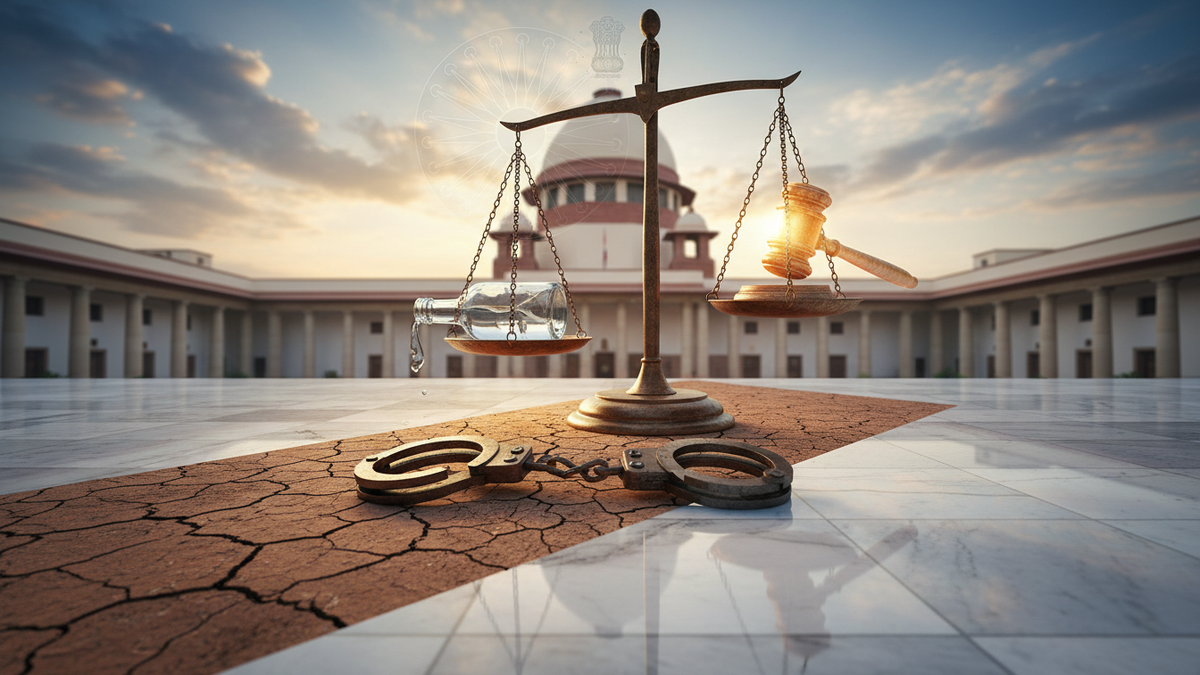
On September 18, 2026, a Supreme Court bench of Justices J.B. Pardiwala and K. Vinod Chandran struck down two provisions of the Maharashtra Poisons Rules, 1972, that had governed the sale of industrial methanol for fourteen years. In M/s Balaji Formalin Pvt. Ltd. v. Union of India, reported as 2026 INSC 1009, the Court held that Rules 18A and 18B — introduced in 2011 to make methanol harder to divert into illicit liquor — were “manifestly arbitrary” and violated Articles 14 and 19(1)(g) of the Constitution. What makes the ruling significant well beyond the petitioners’ balance sheets is what the Court did next: rather than simply leaving a regulatory gap, it used the same judgment to lay out a detailed, nationwide set of directions for how every state and Union Territory should actually try to stop hooch tragedies — the recurring mass poisonings that have killed hundreds of Indians over the decades.
Why Maharashtra Regulated Methanol in the First Place
The rules the Court struck down were not written in a vacuum. In 1991, roughly 250 people at Chhaya Bar in Mumbai consumed spurious liquor that had been laced with methanol, and around 93 of them died. Methanol is chemically similar to the ethanol used in legitimate liquor but is highly toxic even in small quantities, and it is far cheaper — which makes it an attractive, and lethal, adulterant for bootleggers. In response, Maharashtra amended its Poisons Rules in 2011 to insert Rule 18A, which required anyone selling methanol to a non-drug manufacturer to first verify the buyer’s licence (a “Form A” licence) and to add a colourant and a bitterant to the methanol before sale. Rule 18B backed this up by providing for confiscation of methanol found in the hands of an unlicensed purchaser.
The logic was straightforward on its face: if methanol is dyed and made bitter, it becomes both harder to pass off as drinking alcohol and easier for enforcement agencies to spot. For over a decade, the rule stood as Maharashtra’s principal administrative answer to the hooch problem.
The Petitioners’ Case: A Rule That Broke Legitimate Industry
The challenge came from methanol-dependent manufacturers, led by Balaji Formalin Pvt. Ltd., which uses methanol as a feedstock to manufacture paraformaldehyde — a white crystalline industrial chemical used in resins, plastics and other downstream products. The petitioners argued that colouring and embittering their methanol supply was not a minor compliance burden but something closer to a poison pill for their business: a coloured, bitter-smelling input compromises the purity and commercial acceptability of the finished product, and the licensing bottleneck under Rule 18A slowed down and restricted access to a chemical with entirely lawful, non-beverage industrial uses.
The Supreme Court agreed that this was a real constitutional problem, not just a commercial inconvenience. Reporting on the judgment notes that the Court found the rules imposed serious costs on lawful industry without a correspondingly strong justification in preventing the harm they were meant to address.
Applying the Proportionality Test
The heart of the judgment is a proportionality analysis — the now-familiar four-part test Indian courts use to assess whether a restriction on a fundamental right (here, the Article 19(1)(g) right to carry on a trade or business) is constitutionally sound. The Court held that subordinate legislation restricting trade must bear a reasonable, proportionate nexus with its stated object, and that Rules 18A and 18B failed this test.
Identification Is Not Prevention
The Court’s central insight was a distinction between identifying methanol and preventing its diversion. Adding colour and bitterant makes methanol easier to recognise once it has already been diverted or has already entered the illicit supply chain — but it does nothing to stop the theft, pilferage or unauthorised sale that gets it there in the first place. As the Court put it, the measure addressed a symptom (making diverted methanol recognisable) rather than the underlying disease (diversion itself), and a rule that burdens an entire lawful industry to achieve only a cosmetic identification benefit cannot survive scrutiny under Articles 14 and 19(1)(g).
This reasoning matters for regulatory drafting well beyond methanol. Any state rule that restricts a lawful trade in the name of preventing a downstream criminal misuse now has to show the Court a tighter causal link between the restriction and the harm — not just a plausible-sounding connection.
“Forced Temperance Is No Solution”: The Court’s Broader Warning on Prohibition
Where the judgment goes further than a typical administrative-law ruling is in its discussion of prohibition policy itself. The Court pointed to Gujarat, which has maintained statutory prohibition since 1960, yet has recorded at least ten major mass hooch tragedies claiming more than 600 lives — including recent incidents in Bhavnagar (about 13 deaths) and, in Madhya Pradesh’s Sagar district, around 15 deaths. The Bench observed that driving the liquor trade underground through blanket bans tends to push consumption toward unregulated, unsafe and often methanol-laced alternatives, rather than eliminating demand — prompting the Court’s now widely quoted line that forced temperance is no solution for alcoholism. The Court separately cautioned states against repeating “Bihar-type” hooch tragedies, invoking that state’s own prohibition-era mass poisoning incidents as a cautionary precedent.
The Court’s Nationwide Directions
Rather than stopping at striking down the Maharashtra rules, the Bench issued a structured set of directions to every state and Union Territory, effectively sketching a model regulatory framework for methanol control:
Coordinated, Multi-Department Enforcement
States were directed to coordinate action across excise, police, transport, industries and health departments — with civil society and NGOs also enlisted — to check inter-state smuggling at borders, identify illicit distillation or storage sites, and monitor industrial units capable of supplying methanol or other chemicals used in spurious liquor.
Licensing With Teeth
Licences for methanol purchase and use are to be granted only after proper verification of the applicant and reviewed periodically rather than treated as a one-time formality. Industrial users must maintain accurate stock and consumption records and return unused or excess methanol, with suspension or cancellation of licences for violations.
Tamper-Evident Transport
Perhaps the most operationally specific direction concerns transport: containers and tankers carrying methanol must be sealed in a tamper-evident manner at the point of dispatch, in a way that prevents both opening and the siphoning off of residual quantities, with the seal number and its condition recorded both at dispatch and at receipt, and opened only by authorised personnel of the receiving industry.
Health-System Preparedness
Finally, the Court directed that State Health and Family Welfare Departments maintain a dedicated policy and specialised cell for handling mass liquor-poisoning incidents, backed by a proper disaster-management protocol, recognising that even the best preventive regulation will not eliminate the risk entirely.
What This Means in Practice
For Maharashtra’s chemical and industrial sector, the immediate effect is straightforward: methanol can now move through the supply chain to paraformaldehyde, resin and other manufacturers without the licensing and additive requirements that Rules 18A and 18B had imposed, at least until the state legislature or executive frames a replacement regime that can survive the same proportionality scrutiny. Any redrafted rule will need to target actual diversion points — storage, transport, resale — rather than relying on a generic identification marker.
For other states, the judgment is less an invitation to deregulate and more a template to follow: the Court has effectively pre-cleared a specific, granular set of controls — tamper-evident sealing, licence audits, inter-department coordination, health-sector disaster planning — as the kind of measures that can plausibly satisfy both public-safety objectives and constitutional scrutiny. States that still rely on blunt instruments resembling Maharashtra’s struck-down rule now have a reasonably clear judicial signal about what will not hold up.
For lawyers advising regulated industries — chemicals, pharmaceuticals, industrial solvents — the case is also a useful current precedent on how far the proportionality doctrine has moved into ordinary administrative rule-making. It is no longer enough for a government to show that a restriction serves a legitimate purpose in the abstract; it must show that the specific mechanism chosen actually advances that purpose in a real, and not merely symbolic, way.
Frequently Asked Questions
What exactly did the Supreme Court strike down?
The Court struck down Rules 18A and 18B of the Maharashtra Poisons Rules, 1972, which required licensing verification and the addition of colourant and bitterant to methanol sold to non-drug manufacturers, along with the confiscation power attached to unlicensed purchases.
Why did the Court say these rules were unconstitutional?
The Court held the rules violated Articles 14 and 19(1)(g) because they failed the proportionality test: the additive requirement made methanol easier to identify once diverted but did not meaningfully prevent the theft or diversion that leads to its misuse in illicit liquor, while imposing a real burden on lawful methanol-dependent industries.
Does this judgment mean methanol is now unregulated in Maharashtra?
No. The judgment removes the specific licensing-and-additive mechanism under Rules 18A and 18B. It does not exempt methanol from general poisons and industrial-safety regulation, and the Supreme Court’s own directions effectively call for a more targeted regulatory regime, including tamper-evident transport and licence audits, to replace the struck-down approach.
Who were the petitioners in this case?
The lead petitioner was Balaji Formalin Pvt. Ltd., a manufacturer that uses methanol to produce paraformaldehyde, an industrial chemical. It argued that the additive requirement compromised its product and business.
What are the key directions the Supreme Court gave to states?
The Court directed multi-department coordination among excise, police, transport, industries and health authorities; stricter licence verification and periodic review; mandatory stock and consumption records for industrial users; tamper-evident sealing of methanol tankers and containers with seal records at dispatch and receipt; and a dedicated health-department policy and disaster-management protocol for mass liquor-poisoning incidents.
Does the ruling apply only to Maharashtra?
The rules struck down were specific to Maharashtra, but the Court’s directions on licensing, transport security and health-system preparedness were addressed to all states and Union Territories, giving the judgment a practical, nationwide reach even though only one state’s rules were formally invalidated.
Sources
- M/S. Balaji Formalin Pvt. Ltd. Through … vs Union Of India on 18 September, 2026 - Full text of the Supreme Court judgment on Indian Kanoon.
- Supreme Court Strikes Down Maharashtra Rules Mandating Additives In Methanol, Issues Directions To Prevent Hooch Tragedies - LiveLaw’s detailed report on the ruling and its directions.
- Failed Test Of Proportionality: Supreme Court Strikes Down Maharashtra’s Methanol Denaturation Rules - Verdictum’s analysis of the proportionality reasoning.
- Forced Temperance No Solution For Alcoholism: Supreme Court Issues Guidelines To Prevent Hooch Tragedies & Curb Illicit Alcohol Trade - Verdictum’s coverage of the Court’s guidelines and prohibition commentary.
- SC suggests multi-department strategy to prevent hooch tragedies - ThePrint’s report on the Court’s coordination directions and Gujarat prohibition observations.
- Methanol Denaturing Rules Burden Lawful Industries Without Preventing Hooch Tragedies: Supreme Court Strikes Down Maharashtra Provisions - JurisHour’s report on the petitioners’ industry-impact arguments.
- SC Strikes Down Maharashtra Methanol Rules, Flags Dangers of Total Alcohol Bans - Deccan Herald’s coverage of the Court’s prohibition-policy remarks.
- Supreme Court cautions state against Bihar-type hooch tragedies - The Tribune’s report on the Court’s reference to Bihar’s prohibition-era tragedies.