
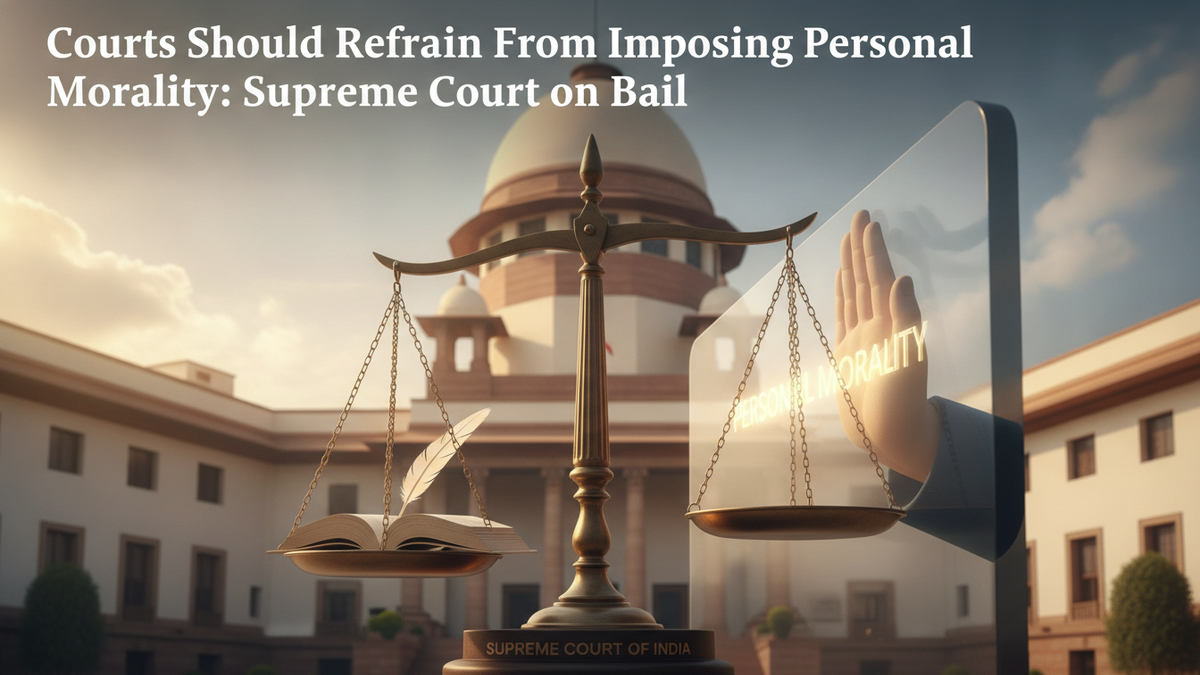
A High Court refused bail to a man accused of sexually exploiting a minor, and part of its reasoning was that releasing him could affect “social order” and the “morals” of the victim’s family. On appeal, the Supreme Court set that reasoning aside. In Kanha @ Kanhaiya Singh v. State of Madhya Pradesh, a bench of Justices Ujjal Bhuyan and Atul S. Chandurkar held that “courts should refrain from imposing the personal views or value judgment of the Presiding Judge on morality or otherwise while adjudicating a matter relating to bail, or even a criminal trial of an accused.”
The order, passed on 23 September 2026 and widely reported on 30 September, is short. But it speaks to a recurring problem in Indian bail practice: bail decisions that lean on a judge’s sense of propriety instead of the statutory and constitutional tests. For defence lawyers, it is a ready citation. For prosecutors and trial courts, it is a reminder of what a bail order must actually be about.
The Case in Brief
The allegations and the charges
According to Bar & Bench, the appellant faced charges under the Bharatiya Nyaya Sanhita, 2023, the Protection of Children from Sexual Offences (POCSO) Act, 2012, and the Scheduled Castes and Scheduled Tribes (Prevention of Atrocities) Act, 1989. The allegations concerned attempted abduction and the sexual exploitation of a minor girl. ETV Bharat reports that the accused was a tenant who allegedly exploited the victim over roughly a month.
These are grave charges, and nothing in the Supreme Court’s order treats them lightly. The question before the bench was narrower: on what grounds can a court deny bail?
What the High Court said
The Madhya Pradesh High Court’s order of 20 March refused bail. As reported by ThePrint, it reasoned that granting bail could harm “social order” and the “morals” of the victim’s family. Neither is a recognised ground for denying bail. Neither depends on the evidence, the risk of flight, the chance of tampering with witnesses, or the likely length of the trial.
What the Supreme Court did
The Supreme Court noted that the appellant had been in custody for more than one year and that the trial would take further time to conclude. On that footing it held that “a case for bail is made out.” It set aside the High Court’s order and directed that the accused be produced before the Special Court within seven days, which would release him on appropriate conditions. According to Bar & Bench, the ruling does not affect his custody in a separate conviction appeal.
Why Morality Is the Wrong Yardstick for Bail
The settled tests
Indian bail law has long been anchored in a few questions: how serious the offence is, whether the accused is likely to flee, whether he may influence witnesses or tamper with evidence, and how long the accused has already been, and is likely to remain, in custody. The classic statement comes from Justice V.R. Krishna Iyer in State of Rajasthan v. Balchand (1977): “the basic rule is bail, not jail,” except where there are circumstances suggestive of fleeing from justice or thwarting the course of justice. The Court revisited the area in Satender Kumar Antil v. CBI (2022), stressing that bail should be the norm and that unnecessary arrests and denials of bail should be curbed.
Bail applications before the High Court and the Sessions Court are today decided under Section 483 of the Bharatiya Nagarik Suraksha Sanhita, 2023, which corresponds to Section 439 of the old CrPC. Nothing in that framework invites a judge to weigh the moral fallout of release on a family or on society at large.
Why subjective morality is risky
Morality-based reasoning has three problems. First, it is unpredictable: two judges can hold different moral views, so identical facts could produce different outcomes. Second, it cannot be tested on appeal, because “social order” and “morals” are not facts that a record can prove or disprove. Third, it risks turning bail into pre-trial punishment. The Supreme Court has said as much in a separate ruling this week. In Sanjay Badaya v. State of Rajasthan (2026 INSC 1065), a bench of Justices Dipankar Datta and Sheel Nagu observed that “pre-trial incarceration cannot masquerade as punitive detention, particularly when the commencement and conclusion of the trial are not imminent.” That case arose from the Jal Jeevan Mission tender matter in Rajasthan, so the facts could hardly differ more, yet the principle is the same: custody before trial is not a sentence.
The Article 21 Dimension
Behind both rulings sits Article 21 of the Constitution. Pre-trial detention is a deprivation of personal liberty, and it must be justified by a legal ground. A judge’s private view of what is morally fitting is not a legal ground. By insisting that the presiding judge’s “personal views or value judgment” stay out of the analysis, the bench reinforced the idea that liberty cannot turn on who happens to hear the matter.
The ruling also does not weaken protection for victims. Courts can still refuse bail where there is a real risk of intimidation, pressure on the victim’s family or witnesses, or flight. Those are evidence-based concerns, and they can be recorded, challenged and reviewed. What the Court has ruled out is shorthand: invoking “morals” or “social order” in place of a reasoned finding.
Practical Implications
For lawyers
- Defence counsel can cite this order where a bail refusal rests on generalised moral or social observations rather than on the evidence or the recognised bail considerations.
- Prosecutors opposing bail in sensitive cases will be better served by concrete grounds: specific threats to witnesses, risk of absconding, the stage of the trial, and the strength of the material on record.
- Trial and High Courts should record reasons tied to the statutory and constitutional framework, not to personal views.
For citizens and families
Accused persons and complainants alike should expect bail to be decided on the facts and the law. For victims’ families, the practical point is that concerns about safety and pressure should be raised specifically, backed by material, so a court can act on them.
Conclusion
Kanha @ Kanhaiya Singh does not expand the law of bail. It restates a boundary: a judge’s moral outlook is not a ground for refusing, or granting, bail. Read alongside Sanjay Badaya, delivered in the same week, it signals that the Supreme Court is attentive to prolonged pre-trial custody and to reasoning that drifts from the legal tests. Even in cases involving serious allegations against a child, the decision must be reasoned in law. One caveat: the order is brief, so its main value is as a clear, quotable statement rather than as a detailed new doctrine.
Frequently Asked Questions
What did the Supreme Court decide in Kanha @ Kanhaiya Singh v. State of Madhya Pradesh?
A bench of Justices Ujjal Bhuyan and Atul S. Chandurkar set aside a Madhya Pradesh High Court order refusing bail and held that courts should not impose a judge’s personal views or value judgment on morality while deciding bail or criminal trials. The accused had been in custody for over a year and the trial was far from complete.
Does this mean people accused of sexual offences against minors will get bail easily?
No. The ruling does not say bail must be granted in such cases. It says the decision must rest on legal grounds such as the evidence, risk of flight, risk of tampering and the length of custody, not on moral views.
Which law governs bail applications in the High Court and Sessions Court now?
Section 483 of the Bharatiya Nagarik Suraksha Sanhita, 2023, which corresponds to Section 439 of the earlier Code of Criminal Procedure.
What is the link between this ruling and Article 21?
Pre-trial custody restricts personal liberty, which Article 21 protects. Denying bail on moral grounds, rather than recognised legal grounds, is hard to reconcile with that protection.
Can a victim’s family still oppose bail?
Yes. Concerns about intimidation, pressure on witnesses or the victim’s safety are legitimate bail considerations, provided they are raised with specifics and supported by material.
Sources
- LiveLaw: Judges Must Avoid Personal Views On Morality While Hearing Bail Pleas Or Criminal Trials - report on the Kanha @ Kanhaiya Singh order
- Bar & Bench: Judges should not impose personal views on morality in bail cases - details of charges, High Court reasoning and Supreme Court quotes
- ThePrint: Courts must refrain from imposing personal views on morality in criminal cases - report on the High Court order date and directions
- ETV Bharat: Law, Not Morality, Should Guide Bail - background on the accused and the case
- Verdictum: Sanjay Badaya v. State of Rajasthan, 2026 INSC 1065 - pre-trial incarceration ruling
- ThePrint: Principle of bail is rule and jail is exception laid down by SC in 1977 - State of Rajasthan v. Balchand
- Indian Kanoon: Satender Kumar Antil v. CBI (2022) - judgment text on bail principles
- ApniLaw: Section 439 CrPC vs Section 483 BNSS - comparison of the bail provisions