
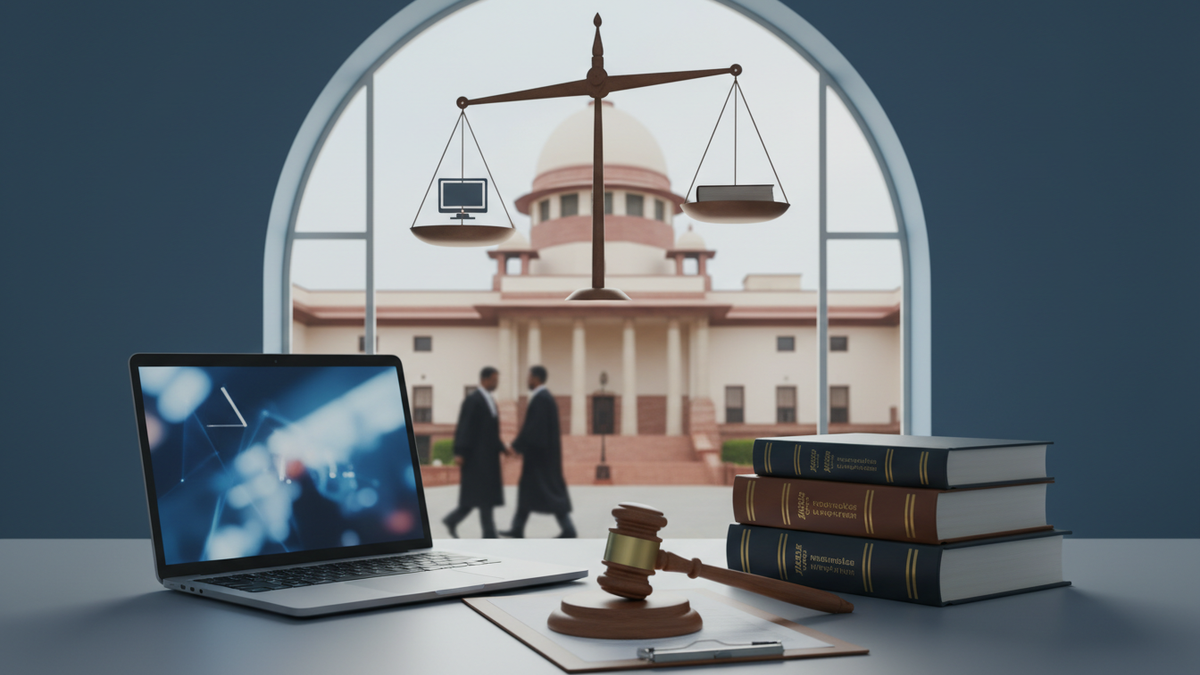
Can a tax department seize a lawyer’s office computer because it suspects the lawyer is more than a lawyer? On 18 September 2026 the Delhi High Court said yes, in limited circumstances. On 28 September 2026 the Supreme Court hit pause. The dispute in Puneet Batra v. Union of India now sits at the meeting point of two powerful ideas: the State’s power to investigate tax fraud and the confidentiality that makes legal advice possible. Its outcome will matter to every practising advocate in India and to every client who has ever handed a lawyer a sensitive document.
The Facts: A Search at a Law Firm
According to the Delhi High Court’s judgment as reported by Verdictum, the GST Department was investigating alleged tax evasion by entities routing payments for an offshore online gambling platform. Its case was that Advocate Puneet Batra, a tax lawyer associated with Bass Legal LLP, was not merely counsel to Matkarma Technology Pvt. Ltd. (MTPL) but was personally embedded in its operations, allegedly earning 0.7% of revenue, a share said to run to over ₹1,306 crore.
On 25 July 2025, officers searched the Bass Legal premises and seized the CPU of the computer in Batra’s cabin along with MTPL-related material, as summarised by TaxGuru. Batra challenged the search, arguing that it invaded advocate-client privilege.
What the Delhi High Court Held
A Division Bench of Justices Anil Kshetarpal and Shail Jain dismissed the writ petition on 18 September 2026 (Bar & Bench).
Privilege is not a shield for the lawyer’s own conduct
The Court held that privilege “cannot operate as an absolute bar against an investigation into the conduct of the Advocate himself” where the authorities place prima facie material indicating that the lawyer may have acted beyond the role of a legal adviser. It added that privilege “attaches to the nature of a communication and the circumstances of its creation, and does not follow merely from the fact that material is found in an Advocate’s office.”
The search authorisation was valid
The search was authorised under Section 67(2) of the CGST Act, 2017. That provision allows a proper officer not below the rank of Joint Commissioner, who has “reasons to believe” that documents useful to proceedings are secreted in a place, to authorise a search and seizure (CBIC text of Section 67). The High Court reasoned that the valid authorisation covered the premises, so a cabin inside them did not become immune because an advocate sat there. It also rejected arguments based on non-compliance with administrative circulars and the absence of a show cause notice to MTPL.
Safeguards for genuinely privileged and third-party data
The judgment did not throw the doors open. The Court kept protections in place for genuinely privileged communications and for the confidential data of unrelated clients. According to the reports, the safeguards included forensic cloning of the seized data under court-appointed IT officials acting as Local Commissioners, identification of MTPL-related files, and a bar on accessing unrelated client data without further court orders. It also held that MTPL’s later consent could not retroactively open unrelated clients’ information to examination.
The Statutory Backdrop: Sections 132 to 134 of the BSA
The privilege debate now runs through the Bharatiya Sakshya Adhiniyam, 2023. Section 132 bars an advocate from disclosing, without the client’s express consent, communications made in the course and for the purpose of professional service, the contents of documents seen for that purpose, or advice given. It corresponds to Section 126 of the old Evidence Act (see this conversion table).
The Supreme Court examined this framework barely a year ago. In In Re: Summoning Advocates Who Give Legal Opinion or Represent Parties (2025 INSC 1275), decided on 31 October 2025 by a bench of CJI B.R. Gavai and Justices K. Vinod Chandran and N.V. Anjaria, the Court held that investigating agencies cannot summon advocates merely because they appeared for or advised an accused. It also held that Sections 132 to 134 protect lawyers from coercion to disclose privileged communications, while in-house counsel are not covered. That ruling concerned summons, not searches, and the Batra case tests whether its logic extends to the seizure of a lawyer’s devices.
Readers interested in the wider pattern may also want our earlier analysis of why the ED’s retreat on attorney-client privilege is not the final word.
The Supreme Court Steps In
Batra moved the Supreme Court. On 25 and 26 September 2026 a bench of Justices Dipankar Datta and Sheel Nagu asked the GST authorities not to analyse the seized data and not to take coercive action until the hearing on Monday, 28 September. Senior advocates N. Hariharan and Vikas Singh appeared for Batra, raising the risk that officers would access privileged client information; the Additional Solicitor General appeared for the Department.
On 28 September the bench stayed the High Court’s judgment and issued notice, allowing three weeks for a response. Batra was directed to appear for investigation on 30 September. Justice Datta questioned why the Department had not disclosed its reasons for the search, and observed that the Department could not itself be the one to decide how privileged material is segregated. These are oral remarks, not findings, but they show where the Court’s concern lies.
Why It Matters
For lawyers
Two propositions can both be true. Privilege protects communications, not the person of the advocate. But an advocate who is alleged to have taken a stake in the client’s business has, on the Department’s case, stepped outside the adviser’s role. The unresolved question is who decides, and at what stage, whether material is privileged or part of a business relationship. The Supreme Court’s remark that the Department cannot be judge in its own cause on segregation suggests that any workable protocol will need independent oversight.
For clients
Clients of a law firm can be affected by a search targeting one lawyer. The High Court’s own safeguards for unrelated client data acknowledge this risk. Whether that protection is sufficient once a device has been seized and imaged is likely to be tested at the final hearing.
For investigating agencies
The stay is a reminder that “reason to believe” under Section 67 is a substantive precondition. Searches of professional premises are likely to face demands for disclosure of the recorded reasons, and agencies will need a documented, prima facie basis for treating a lawyer as a participant rather than an adviser.
Practical Takeaways
- Keep client files logically segregated, with clear matter-wise labelling of devices and folders, so that unrelated client data can be identified and protected quickly.
- Record the scope of engagement in writing; a defined advisory role is the best evidence that communications were made in the course of professional service.
- If a search occurs, ask for the authorisation and note its terms, assert privilege at the time, and seek immediate judicial directions on how devices are to be handled.
- Watch the final outcome: the Supreme Court’s eventual ruling could set the national standard for searches of law offices.
Conclusion
The Delhi High Court tried to balance the two interests with a fact-specific rule and court-supervised safeguards. The Supreme Court has, for now, suspended that balance and asked the Department to explain itself. Whatever the final answer, the case signals that privilege in India is being defined not only in the courtroom but at the point of seizure, and that lawyers, clients and agencies all need clearer rules before the next search.
Frequently Asked Questions
Did the Delhi High Court say lawyers’ offices can be searched freely?
No. It held that privilege cannot bar an investigation into an advocate’s own conduct where prima facie material suggests the lawyer acted beyond a legal adviser’s role. It also kept protections for genuinely privileged and unrelated third-party client data.
What has the Supreme Court decided so far?
On 28 September 2026 it stayed the Delhi High Court’s judgment, issued notice and gave the Department three weeks to respond. It has not yet ruled on the merits.
Which law governs advocate-client privilege now?
Sections 132 to 134 of the Bharatiya Sakshya Adhiniyam, 2023. Section 132 corresponds to Section 126 of the old Evidence Act.
What is the power under Section 67 of the CGST Act?
It allows a proper officer not below the rank of Joint Commissioner, who has reasons to believe that documents relevant to proceedings are secreted somewhere, to authorise a search and seizure. The belief must be based on material, not mere suspicion.
Does this affect other clients of the law firm?
Potentially, because devices at a law firm can hold data of many clients. The Delhi High Court barred access to unrelated client data without further court orders, and the Supreme Court has now paused the wider judgment.
Sources
- Verdictum: Delhi High Court judgment in Puneet Batra v. Union of India - report of the 18 September 2026 ruling
- Bar & Bench: Delhi High Court allows GST search of advocate’s office - coverage of the High Court decision
- TaxGuru: Delhi HC upholds CGST search with privilege safeguards - facts, issues and safeguards
- LiveLaw: Supreme Court stays Delhi High Court judgment - 28 September 2026 order
- Daily Pioneer: Search of Delhi lawyer’s office, SC asks GST authorities - interim directions of 26 September
- CBIC: Section 67, CGST Act, 2017 - statutory text on search and seizure
- LiveLaw: No summons to advocates except under S.132 BSA exceptions - Supreme Court directions of 31 October 2025
- Verdictum: In-house counsel not entitled to privilege under S.132 BSA - analysis of 2025 INSC 1275
- Indian Kanoon: Section 132, Bharatiya Sakshya Adhiniyam, 2023 - text of the privilege provision