
Summary of the Judgment
- Case Name: Serious Fraud Investigation Office v. Aditya Sarda & Others
- Date of Judgement: 9 April 2025
- Bench: Hon’ble Justice Bela M. Trivedi
- Advocates:
- Acts & Sections Involved:
- Key Cited Judgements:
Introduction
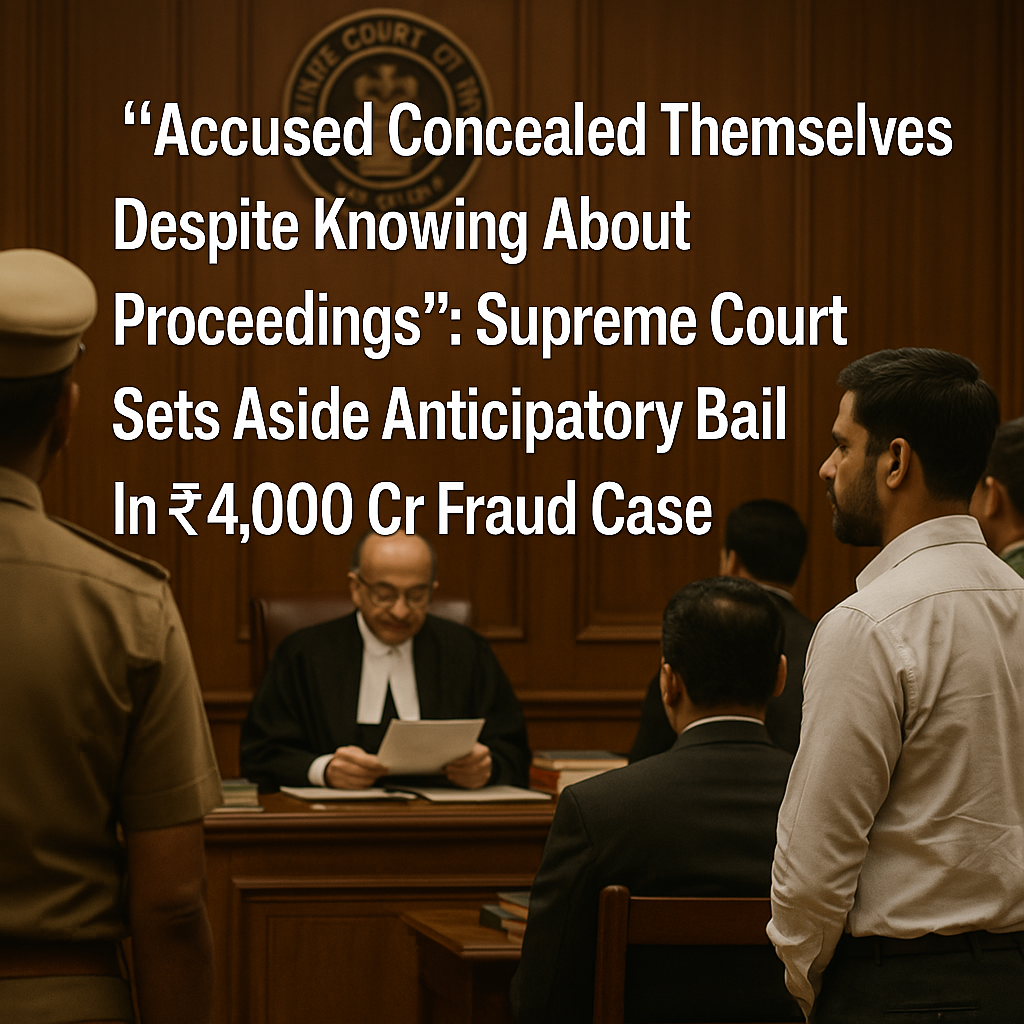
In a much-anticipated decision dated 9 April 2025, the Supreme Court of India, through Hon’ble Justice Bela M. Trivedi, delivered a comprehensive judgement in Serious Fraud Investigation Office v. Aditya Sarda & Others. The case not only reaffirms the principles surrounding anticipatory bail in economic offences but also underscores judicial intolerance towards deliberate evasion of criminal processes.
This judgement, involving a batch of sixteen appeals, stemmed from investigations into the financial mismanagement and fraudulent activities by entities linked with the Adarsh Credit Cooperative Society Limited (ACCSL). It has since attracted attention for its stern reiteration of law enforcement obligations and judicial expectations in the prosecution of complex financial crimes.
The Crux of the Matter
The Serious Fraud Investigation Office (SFIO), under Section 212 of the Companies Act, 2013, was tasked to investigate the affairs of over 145 entities, including 125 companies and 20 others, affiliated with the Adarsh Group. The inquiry unearthed a systematic siphoning of public funds—amounting to over ₹4,120 crores—through illegal loans to shell entities allegedly controlled by the Modi family.
The SFIO’s investigation report, submitted to the Ministry of Corporate Affairs (MCA), formed the basis for a criminal complaint lodged with the Special Court at Gurugram in May 2019. It invoked multiple penal and corporate law provisions against 181 accused individuals, including charges under Sections 447 (punishment for fraud), 448 (false statements), and 76A of the Companies Act, 2013.
Pattern of Evasion
What is particularly telling in this matter is the respondents’ conduct post-cognizance. Despite the issuance of summons and, subsequently, bailable and non-bailable warrants (NBWs), several accused failed to appear. The Special Court eventually initiated proceedings under Section 82 of the CrPC for declaring them proclaimed offenders.
The Supreme Court was forthright in stating:
“There is no justification coming forth from the respondents as to why after the rejection of their anticipatory bail applications by the Special Court, they did not appear before the Court and made themselves unavailable at the given addresses.”
This behaviour, as observed, was not incidental but a calculated evasion. Repeated NBWs returned unexecuted with excuses ranging from ‘house locked’ to ‘not residing at the address’. In some instances, family members or domestic staff claimed the accused were unavailable, further impeding lawful process.
High Court Interference and the Apex Court’s Critique
Most of the respondents had earlier been denied anticipatory bail by the Special Court. Nevertheless, they later secured it from the High Court in March and April 2023. The SFIO challenged these orders before the Supreme Court.
The Apex Court allowed some of the appeals, noting that anticipatory bail should not be granted routinely, especially in cases involving “economic offences of grave magnitude”.
Quoting P. Chidambaram v. Directorate of Enforcement, the judgement reiterated:
“The privilege of pre-arrest bail should be granted only in exceptional cases… particularly in serious economic offences involving large-scale fraud, public money or complex financial crimes.”
Similarly, in Y.S. Jagan Mohan Reddy v. CBI, the Court emphasised that such offences affect not merely individual victims but undermine national economic integrity. The Supreme Court strongly relied on this jurisprudence in reversing several High Court orders.
On the Legal Mechanics: Warrants and Proclamations
Justice Trivedi gave a precise exposition on procedural powers under Sections 204 and 82 CrPC. She held that once a court is satisfied that an accused is deliberately avoiding process, non-bailable warrants and proclamation orders are justified.
Citing Inder Mohan Goswami v. State of Uttaranchal, the Court explained:
“Non-bailable warrants should be issued when it is reasonable to believe that the person will not voluntarily appear in court.”
This was undoubtedly the case here. The accused, despite being aware of proceedings (as evidenced by their bail applications), chose not to appear, frustrating investigation and due process.
The Limits of Anticipatory Bail
The judgement also makes a timely intervention in clarifying the contours of anticipatory bail, especially under Section 212(6) of the Companies Act, 2013. This provision, read with Section 447, explicitly restricts bail for economic offences unless the public prosecutor has been given a hearing and the court is satisfied about the innocence of the accused.
“Anticipatory bail can be granted only in exceptional circumstances where the court is prima facie of the view that the applicant has falsely been enroped in the crime and would not misuse his liberty.”
The Court’s emphasis here has significant implications for ongoing and future white-collar crime prosecutions.
A Judicial Warning to Economic Offenders
This judgement serves as a clear message to financial offenders and white-collar criminals. The procedural leniencies often misused—such as anticipatory bail or delay tactics—will be scrutinised through the lens of larger public interest.
Referring to Nimmagadda Prasad v. CBI, the Court echoed:
“A murder may be committed in the heat of the moment… An economic offence is committed with cool calculation and deliberate design with an eye on personal profit regardless of the consequence to the community.”
Such distinctions form the backbone of contemporary judicial reasoning, where economic crimes are increasingly viewed as acts of betrayal against public trust.
Conclusion
The Supreme Court’s judgement in SFIO v. Aditya Sarda & Others is a vital precedent in balancing individual liberties with systemic accountability. By upholding the SFIO’s appeal in key matters and laying down stern principles for anticipatory bail in economic offences, it has reaffirmed that the wheels of justice cannot be derailed by evasive conduct or procedural exploitation.
For legal practitioners, especially those engaged in criminal, economic, or corporate litigation, this decision is both a warning and a guidepost. It reminds us that procedural safeguards must be exercised with care, and justice must remain rooted in both principle and practicality.