
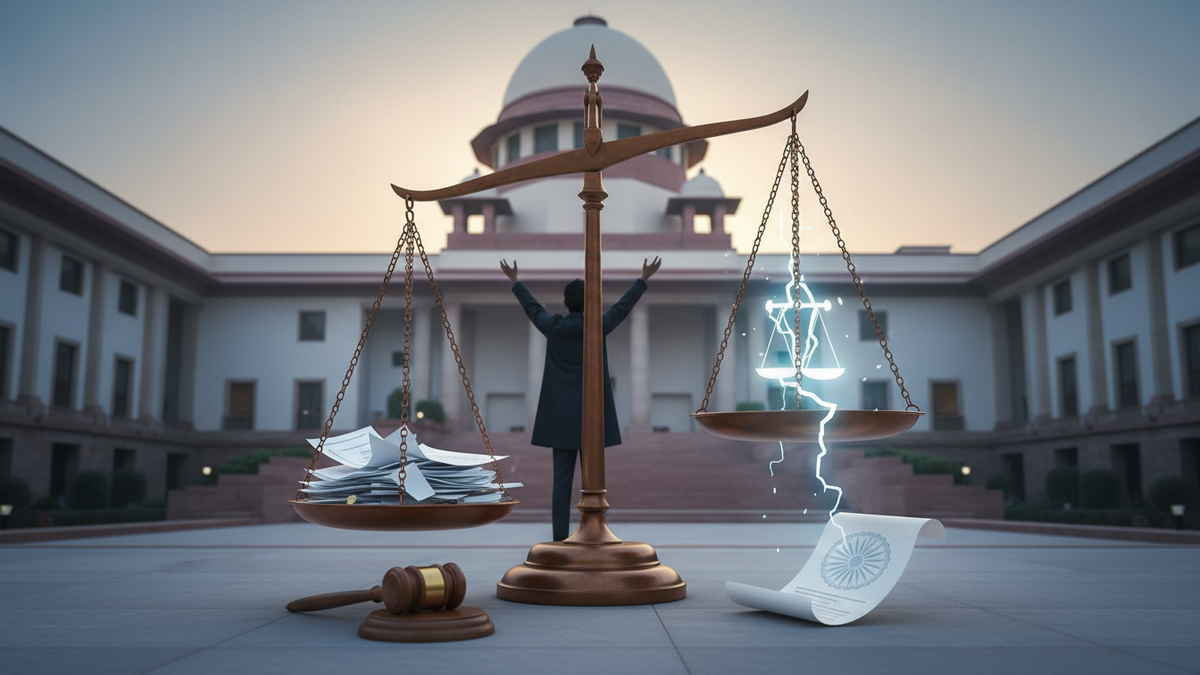
On August 25, a single judge of the Supreme Court told Tarun Tejpal, once the celebrated founder-editor of Tehelka, that he had two weeks to walk into a Goa prison. Not to hear his appeal. Not to argue the merits of the case that has followed him for thirteen years. Simply to surrender, file a certificate proving he had done so, and only then — perhaps a month from now, perhaps longer — would a division bench even begin listening to why his conviction for rape should be overturned. His senior counsel, Kapil Sibal, argued that surrender was an unnecessary cruelty before the appeal had even been heard on its merits. Justice Alok Aradhe was unmoved. The order stands as one of the cleaner illustrations in recent memory of a principle that sounds harsh stated plainly but is, in fact, the quiet architecture holding up appellate criminal law in this country: once a court of competent jurisdiction convicts you, the presumption of innocence you enjoyed through your trial does not simply carry over into the appeal. You do not get to remain, in the eyes of the law, an innocent man while you argue that you shouldn’t be treated as a guilty one. That flip is not incidental to the Tejpal case. It is the whole point of it, and understanding why the Supreme Court felt no discomfort in ordering a sixty-something former journalist into custody before hearing a word of his defence tells us something useful about how criminal appeals are supposed to work — and about the very different, very high bar a court had to clear to convict him in the first place.
Start with the facts, because they matter and because this case has accumulated enough retellings that the sequence is worth restating cleanly. In November 2013, a young colleague at Tehelka accused Tejpal of sexually assaulting her twice inside a hotel elevator during the magazine’s annual ThinkFest conference in Goa. He stepped down as editor within days, describing the episode in an internal email as “a bad lapse of judgment,” language that would later be read back to him in court as something close to an admission. Goa Police filed an FIR, then a chargesheet running past 2,800 pages, built on CCTV footage, witness statements, forensic material and Tejpal’s own emails. The trial itself did not begin until 2017, and in May 2021 the sessions court at Mapusa acquitted him. The Goa government appealed that acquittal to the Bombay High Court, and on August 6 this year — nearly thirteen years after the original complaint — a bench of Justices Neela Gokhale and Amit Jamsandekar reversed it, convicting Tejpal under provisions covering rape by a person in a position of trust, sexual harassment and assault with intent to disrobe, and sentencing him to ten years’ rigorous imprisonment. Their judgment did not mince words about the court they were overruling. “The appreciation of evidence by the Trial Court is not only unreasonable but perverse,” they wrote, going on to reject what they called the “perfect victim” construct — the unspoken expectation, built into how the sessions court had read the complainant’s conduct, that a genuine survivor behaves in a particular, recognisably distressed way, rather than however an actual human being copes with trauma. It is that finding of perversity, not a passing preference for one reading of the evidence over another, that did the legal work of unlocking the appeal in the first place.
There is a detail in the timeline that compliance officers and HR heads reading this case will recognise immediately, and it is easy to miss amid the appellate procedure: the alleged assault happened in November 2013, weeks before the Sexual Harassment of Women at Workplace (Prevention, Prohibition and Redressal) Act came into force on December 9 that year. Tehelka had no statutory obligation yet to run an Internal Complaints Committee, no mandated redressal timeline, no external member requirement — the entire apparatus that now exists precisely so that an allegation like this one does not have to travel straight to a police station and a thirteen-year criminal docket to get any institutional response at all. The magazine’s own internal handling of the complaint, an ad hoc panel convened after the fact, became a subplot in the broader controversy, criticised for procedural gaps that a properly constituted Internal Committee under the later Act would have been designed to avoid. For businesses today, the lesson embedded in that timing gap is not historical trivia. It is the entire argument for taking Internal Committee constitution, training and documentation seriously rather than treating the POSH Act as a compliance checkbox: the alternative, when the internal mechanism fails or does not exist, is not a quieter outcome. It is exactly the years-long, reputation-defining criminal process this case has become, for the institution as much as the individual.
This is worth dwelling on, because the loudest objection to what happened this week — that it is strange, even punitive, to jail a man before his own appeal has been argued — misunderstands what an appeal against acquittal actually requires under Indian law, and what already happened before Tejpal ever got near the Supreme Court. Reversing an acquittal is not the same procedural move as upholding a conviction on first appeal. The Supreme Court settled the governing standard nearly two decades ago in Chandrappa v. State of Karnataka, holding that an accused who has been acquitted carries what the Court called a “double presumption” in his favour: the ordinary presumption of innocence that attaches to anyone facing trial, reinforced a second time by the fact that a competent court has already looked at the evidence and found it wanting. An appellate court cannot disturb that acquittal merely because it might have weighed the same facts differently. It needs “substantial and compelling reasons” — language the Supreme Court itself has since described as more a signal of judicial reluctance than a precise legal test, but a real threshold nonetheless. When the Bombay High Court called the trial court’s reasoning “perverse,” it was not using a loose adjective; it was doing the specific doctrinal work the law demands before an acquittal can be touched at all. Whatever one makes of the outcome, the High Court did not take a shortcut to get there. It cleared the harder bar, not the easier one.
Once that bar is cleared and a conviction results, a second and distinct doctrine takes over, and this is the one the Supreme Court applied on August 25. The presumption of innocence that shields a person during trial and during an appeal against acquittal does not automatically extend to a person appealing against their own conviction. The Court has said as much repeatedly in recent years, holding that after a conviction the appellate court is no longer required to proceed on the assumption that the accused is innocent, and that suspending a sentence pending appeal is meant to be the exception rather than the rule, particularly for serious offences. That is precisely why Kapil Sibal’s argument — hear the appeal first, spare the surrender until then — was always going to be an uphill one. It asked the Court to treat a conviction as provisional in a way the law simply does not, absent the kind of exceptional circumstance (advanced age, grave illness, a genuinely arguable point of law that could unravel the whole conviction) that Indian courts have carved out narrowly and applied sparingly. Justice Aradhe’s short, unadorned order — surrender within two weeks, file the certificate, then and only then will the division bench take up the appeal on merits — is not an outlier. It is the doctrine working exactly as designed.
None of this should be read as an argument that appellate rights are decorative, or that the thirteen years this case has taken are a triumph of process rather than an indictment of it. They are both, and a serious reckoning with this case has to hold both truths at once. A trial that begins four years after the alleged offence and produces an acquittal eight years after that, followed by a High Court reversal five years further on, is not a system functioning as intended; it is a system that took thirteen years to give one complainant a single conviction that even now is not final. That delay is not a footnote to the Tejpal case. It is close to the whole story of how sexual assault prosecutions move — or fail to move — through Indian courts, and the numbers back up the impression the timeline leaves. The National Crime Records Bureau’s most recently published disposal data, for 2022, records a conviction rate of roughly 27.5 percent in rape cases that reached a verdict that year, against a backdrop of well over a hundred thousand such trials still pending nationally that same year. A system that convicts in barely more than one case in four, and takes over a decade to do even that much when it eventually does, cannot claim the presumption-of-innocence architecture is functioning smoothly just because the doctrine, applied narrowly to this one order, is internally coherent. The coherence of the rule and the health of the system it operates inside are two separate questions, and it is a mistake — one this case tempts commentators toward in both directions — to answer one by pointing only at the other.
It is also worth resisting the temptation to read this case purely as a #MeToo-era corrective, satisfying in the way overdue accountability always is, and stopping the analysis there. The genuinely interesting legal move the Bombay High Court made was not that it believed the complainant over the accused — trial courts and appellate courts alike are asked to make exactly that kind of credibility judgment every day. It was that the High Court identified a specific, nameable error in the trial court’s reasoning: an implicit standard for what a “real” victim looks and behaves like, applied to discount testimony that did not fit it. That is a legal error, not merely a different reading of facts, and it is the kind of error that shows up across far more ordinary cases than this one — cases involving no famous defendant, no national media coverage, no thirteen-year arc — where a survivor’s composure on the stand, or lack of visible distress, or delay in reporting, quietly does the work of an acquittal without ever being named as the reason. If the Tejpal judgment has a durable legacy beyond this one defendant, it will not be the surrender order that made headlines this week. It will be trial judges elsewhere reading Justices Gokhale and Jamsandekar’s reasoning and asking themselves, before the next case, whether they too are quietly measuring a complainant against a cultural archetype of how a “proper” victim ought to have behaved.
There is a reasonable worry sitting underneath all of this, and it deserves to be named rather than waved away: a legal system that makes it easier, even marginally, to reverse acquittals in high-profile cases risks doing the same in cases where the trial court got it right and the appellate court is simply under different pressure — public attention, institutional embarrassment, the desire to be seen correcting a wrong. The double-presumption standard from Chandrappa exists precisely as a check against that risk, and its survival depends on appellate courts actually applying it with the rigour the label “perverse” implies, rather than reaching for the word whenever a result feels unsatisfying. That is not a reason to doubt this particular judgment, which grounds its reversal in specific, examined evidence rather than a general sense that the trial court’s conclusion felt wrong. But it is a reason to watch what appellate courts do with acquittals in the less scrutinised cases that never make it past a district court roundup, where there is no Kapil Sibal, no Supreme Court diary number, and no journalist tracking the docket. The safeguard against a system that reverses acquittals too readily is not sentiment about any one defendant. It is disciplined, consistent application of a standard that is supposed to be hard to meet precisely so that when it is met, as the Bombay High Court found it was here, nobody can credibly say the bar was lowered to get there.
Tejpal will very likely surrender before his deadline, file his certificate, and eventually get the merits hearing his lawyers have been asking for all along — the Supreme Court has not shut that door, only insisted he walk through the prison gate before it opens. Whatever a division bench eventually decides about his appeal, the more consequential outcome of this month may already be behind us: a High Court, given the rare chance to correct what it identified as a legally flawed acquittal, did the specific work the doctrine requires rather than simply substituting its own gut instinct for the trial court’s, and a Supreme Court, asked to treat a conviction as a formality pending review, declined to do so. Both of those are, in the narrow sense that matters to how the law actually operates, the system functioning as intended. Whether the system built around that doctrine can be trusted to work this cleanly for a complainant with no famous defendant and no national headline is the question this case leaves genuinely open, and it is the one worth still asking long after Tejpal’s own appeal is finally heard.