
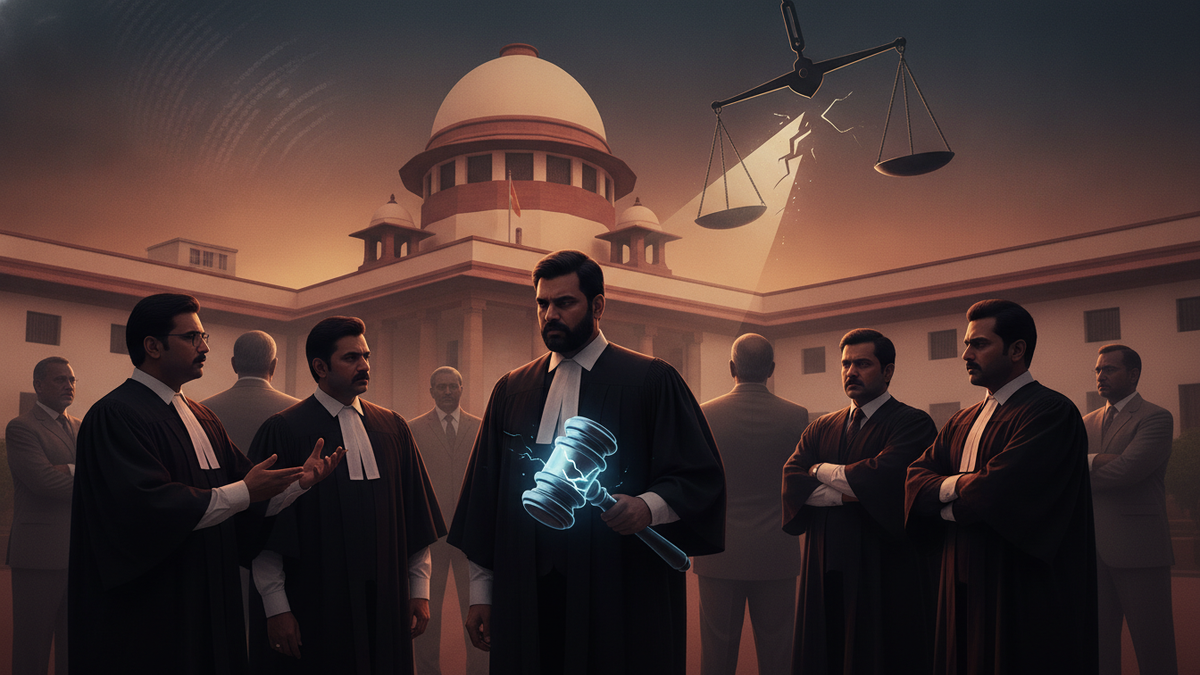
On the morning of September 7, 2026, Justice Ashwani Kumar Mishra was sworn in as the 37th Chief Justice of the Punjab and Haryana High Court at Punjab Lok Bhavan, Chandigarh. Haryana’s Chief Minister sat in the front row. Punjab’s did not turn up. A day earlier, the Punjab Cabinet had unanimously passed a resolution calling the appointment “a direct violation of the prescribed procedures (Memorandum of Procedure) and constitutional norms,” and had written to the President, the Prime Minister, and the Governor asking them to put the oath on hold (LiveLaw). The ceremony went ahead anyway.
It is easy to read this as one more round of Centre-state theatre. It is actually a live test of a question India’s Constitution has never fully settled: what happens when the elected government of a state and the collegium-driven machinery that appoints judges disagree, and the Centre simply proceeds? The answer this week was that procedure lost to the calendar — but the underlying dispute, over how much weight a state’s voice actually carries in appointing the head of its own High Court, is far from resolved.
What Happened, in Sequence
The Supreme Court Collegium, headed by Chief Justice of India Surya Kant, recommended Justice Mishra’s elevation on August 6, 2026 (Bar & Bench). Justice Mishra, transferred to the Punjab and Haryana High Court from Allahabad in July 2025, had been serving as Acting Chief Justice since June 1, 2026, after the elevation of Justice Sheel Nagu to the Supreme Court. Punjab says it was asked for its views on the proposal around August 12, but the Centre cleared and notified the appointment late on Saturday, September 5, without waiting for the state’s formal response (Tribune). The notification came bundled with seven other Chief Justice appointments across the country, part of a single exercise that the Law Ministry says has now given all 25 High Courts a regular, sitting Chief Justice (SCC Online).
Punjab’s Cabinet met the next morning, Sunday, September 7, and passed its resolution, demanding that “the appointment and administration of oath should be put on hold until Punjab’s views are obtained and duly considered.” By the time that resolution reached Raj Bhavan, however, the oath ceremony was already fixed for Monday morning. Punjab Governor Gulab Chand Kataria — who is also the UT Chandigarh Administrator — administered the oath as scheduled (Tribune). Chief Minister Bhagwant Mann said Punjab’s voice was “being suppressed” and that the state’s “permission was sought” but the appointment was made regardless (Tribune). He has separately tied the episode to a wider pattern of what he calls federal overreach, alongside the Centre’s alleged withholding of roughly ₹9,000 crore in Rural Development Fund dues owed to Punjab, a dispute that is itself pending before the Supreme Court (Tribune).
The Two Different Consultations Being Confused
Much of the public argument has treated “consulting the Governor” and “consulting the state government” as the same thing. They are not, and the distinction matters.
Article 217: The Governor, Not the Cabinet
Article 217(1) of the Constitution provides that every High Court judge “shall be appointed by the President… after consultation with the Chief Justice of India, the Governor of the State, and, in the case of appointment of a Judge other than the Chief Justice, the Chief Justice of the High Court” (Constitution of India). This is a constitutional requirement, but the consultee named in the text is the Governor as a constitutional office, not the state’s Council of Ministers. Ordinarily, under Article 163, a Governor acts on the aid and advice of the Council of Ministers — so in the normal run of things the state government’s view reaches the President through the Governor’s opinion. But that chain depends on the Governor actually routing the question through the Cabinet, and on the Governor being willing to transmit the state’s position rather than a personal one. Where a Governor and an elected state government are politically at odds — a fault line that has produced separate Supreme Court litigation in recent years over bill assent and legislative business — the Article 217 consultation can be satisfied at the level of the Governor’s office without ever reflecting the state Cabinet’s actual view.
The Memorandum of Procedure: A Convention, Not a Statute
Punjab’s resolution leans not on Article 217 directly but on Paragraph 6 of the Memorandum of Procedure (MoP) for the appointment of Chief Justices and judges of High Courts. That paragraph provides that after the Chief Justice of India’s recommendation is received, the Union Law Minister is to obtain the views of the state government concerned before the proposal goes to the Prime Minister and then the President. This document is not a law passed by Parliament; it is an administrative protocol that emerged from the Supreme Court’s own Second and Third Judges Cases as the operating manual for the collegium system, and its contours have been revisited since, including in the wake of the 2015 judgment striking down the National Judicial Appointments Commission. Because the MoP has never been formally codified as binding legislation, a breach of Paragraph 6 is a serious procedural lapse and a legitimate political grievance — but it does not, by itself, give a court an obvious statutory hook to declare an appointment void once notified and the oath administered.
This Has Happened Before — Differently
Punjab’s own submission points to a precedent it says shows selective treatment. In July 2024, the collegium recommended Justice Gurmeet Singh Sandhawalia, then a Punjab and Haryana High Court judge, as Chief Justice of Madhya Pradesh. That resolution was not notified for months, reportedly because Madhya Pradesh’s government did not return its views — and in September 2024 the collegium withdrew the Madhya Pradesh proposal and instead recommended Sandhawalia for Himachal Pradesh, where he was sworn in that December (Tribune; Punjab’s framing of the comparison via Bar & Bench). Punjab’s argument is that a receiving state’s silence was allowed to stall an appointment for two months in 2024, while its own state’s objection this week was brushed past in under 48 hours. The comparison is not perfectly apples-to-apples — one case involved a destination state that never replied, the other involves a home state actively objecting after the fact — but it is precisely the kind of inconsistency that makes the Centre’s handling look political rather than procedural.
The Punjab and Haryana High Court Bar Association weighed in along similar lines, warning that “any action that creates an impression of political or Executive pressure upon the judiciary has the potential to erode public confidence in the administration of justice” (Bar & Bench).
Why the Objection Is Unlikely to Unwind the Appointment
However legitimate the procedural complaint, Punjab faces a structural problem: since the Second and Third Judges Cases, the executive’s role — Union or state — in judicial appointments has been read as consultative, not concurrent. The collegium’s recommendation, once reiterated, binds the government to act on it; a state’s disagreement can, at most, delay or embarrass the process, not veto it. A resolution passed after the President has already signed the warrant of appointment, and after the oath has already been administered by the constitutionally designated authority, has essentially no forum in which to be litigated — short of a writ petition seeking to declare the appointment void for breach of the MoP, a claim that would run headlong into decades of case law treating the collegium’s substantive judgment as effectively final and treating procedural lapses in consultation as, at most, irregularities rather than grounds for invalidation.
The Broader Federalism Backdrop
That is also why this dispute is unlikely to end with Justice Mishra. Punjab has explicitly linked it to its wider grievance about the Centre bypassing the state government — from withheld development funds to, now, judicial appointments — a pattern that mirrors similar Centre-state and Governor-versus-Cabinet standoffs that have reached the Supreme Court from other states in recent years. Expect Punjab’s objection to resurface as political ammunition rather than a live legal challenge: in the state assembly, in future correspondence over judicial vacancies, and potentially as one more data point the next time Parliament revisits judicial appointment reform.
Practical Implications
For litigants and lawyers before the Punjab and Haryana High Court, nothing changes: Justice Mishra’s oath was validly administered by the Governor, and his authority as Chief Justice — over roster, administration, and judicial functions — is not in legal doubt merely because a state Cabinet objects to the process that preceded it. For state governments more broadly, the episode is a reminder that Paragraph 6 consultation, unlike Article 217’s Governor consultation, has no independent constitutional anchor — which means its practical value depends entirely on the Centre choosing to honour the timeline it sets for itself. And for anyone tracking judicial-appointment reform, this is fresh evidence for the recurring argument that the MoP, more than a decade after the NJAC judgment directed its revision, still leaves basic questions — how long a state gets to respond, and what happens if the Centre doesn’t wait — unanswered on paper.
Frequently Asked Questions
Is Justice Mishra’s appointment as Chief Justice legally valid despite Punjab’s objection?
Yes. The appointment was made by presidential warrant following the Supreme Court Collegium’s recommendation, and the oath was administered by the Governor, the constitutionally designated authority under Article 217. Punjab’s objection concerns the process that preceded the notification, not the notification’s validity itself, and no court has stayed or set aside the appointment.
What exactly does the Memorandum of Procedure require the Centre to do?
Paragraph 6 of the MoP for High Court Chief Justice and judge appointments requires the Union Law Minister to obtain the concerned state government’s views after the Chief Justice of India’s recommendation is received, before forwarding the proposal to the Prime Minister and then the President. It does not set a fixed deadline for the state to respond, which is part of what makes disputes like this one hard to adjudicate.
Does Article 217 require the Centre to consult the Punjab government, not just the Governor?
No. Article 217(1) requires consultation with the Governor of the state as a constitutional office. In ordinary practice the Governor’s view reflects the state Cabinet’s advice under Article 163, but the two are not legally identical, and a Governor who transmits an opinion without fully canvassing the Cabinet does not, on the text of Article 217 alone, breach the Constitution.
Can Punjab still legally challenge the appointment?
In theory, Punjab or an affected party could file a writ petition arguing the appointment is vitiated by a breach of the Memorandum of Procedure. In practice, courts have consistently treated the collegium’s substantive recommendation as binding once reiterated and have been reluctant to invalidate a notified, sworn-in appointment for a procedural lapse in consultation, making such a challenge an uphill one.
Has a state ever successfully blocked or delayed a collegium appointment like this before?
Not quite in this posture. The closest parallel is Justice Gurmeet Singh Sandhawalia’s 2024 transfer, where the Madhya Pradesh government’s failure to respond stalled his appointment there for roughly two months before the collegium redirected him to Himachal Pradesh — a case of a destination state’s silence causing delay, not a home state formally objecting after notification, as Punjab has done here.
What is the practical effect of the Punjab Cabinet’s resolution now that the oath has been taken?
Its immediate legal effect is limited — it does not undo the appointment. Its practical effect is political: it is now on record as a formal state objection, usable in future correspondence with the Centre, in the state assembly, and potentially as supporting material if judicial appointment reform is revisited.
Sources
- LiveLaw: Punjab Government Opposes Justice Ashwani Kumar Mishra’s Appointment As Chief Justice Of P&H High Court - reports the Cabinet resolution’s language and the timeline of the Centre’s clearance.
- Bar & Bench: Punjab government opposes Justice Ashwani Kumar Mishra’s elevation as High Court Chief Justice - details the Sandhawalia precedent comparison and the Bar Association’s statement.
- The Tribune: Punjab urges President, PM to stall new Chief Justice’s swearing-in - reports the August 12 consultation claim and the Saturday-night notification.
- The Tribune: From Acting CJ to Chief Justice of Punjab and Haryana High Court: Justice Mishra takes oath - covers the September 7 oath ceremony and the CMs’ attendance.
- The Tribune: Bhagwant Mann questions Centre’s handling of HC Chief Justice appointment - covers the Chief Minister’s remarks linking the dispute to withheld Rural Development Fund dues.
- SCC Online: Chief Justice appointments across 8 High Courts notified - confirms the batch notification of eight Chief Justices completing the roster for all 25 High Courts.
- Constitution of India: Article 217 - Appointment and conditions of the office of a Judge of a High Court - full text of the constitutional consultation requirement.
- The Tribune: Justice Sandhawalia takes oath as Chief Justice of Himachal Pradesh High Court - background on the 2024 precedent Punjab has cited.