
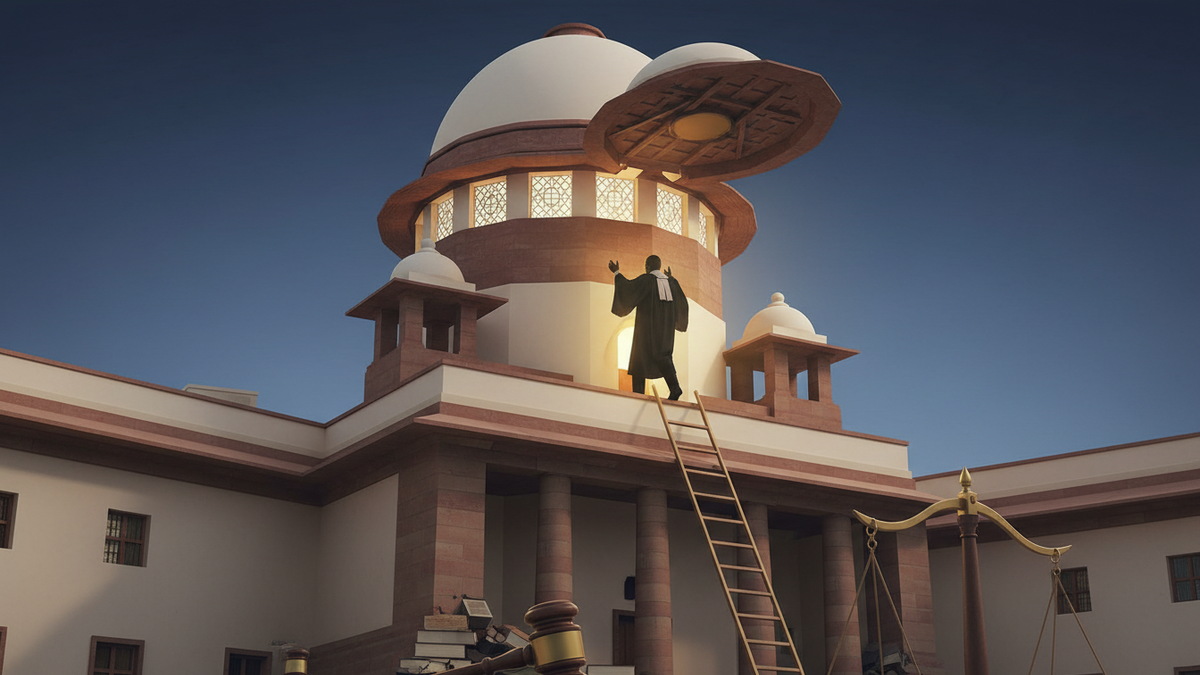
On September 3, 2026, the Supreme Court of India issued a notice that, on paper, looked almost bureaucratic. A bench led by Chief Justice Surya Kant asked the Union government to respond to a writ petition by one Pratik Vira, and posted the matter for September 17. Read the petition itself, though, and the bureaucratic gloss falls away fast. Vira wants the Court to declare that any constitutional functionary who resigns to dodge removal from office forfeits every pension, perk, and privilege that would otherwise have followed them into retirement. Strip away the legal Latin and the question is almost embarrassingly simple: if you quit the moment the walls close in, should the country still pay you as though you served with distinction? For a legal system that has spent decades treating judicial pensions as untouchable, that is a genuinely radical thing to ask out loud, and it deserves a clear answer rather than another two decades of institutional silence.
The petition did not emerge from nowhere. It is impossible to read it without thinking of Justice Yashwant Varma, the Allahabad High Court judge whose name became shorthand for a certain kind of scandal after firefighters, responding to a blaze at his official Delhi residence in March 2025, found charred wads of cash stashed in a storeroom. What followed was a slow-motion institutional reckoning: an in-house Supreme Court inquiry, a recommendation that Varma resign or seek voluntary retirement, his refusal, and then a formal removal process under the Judges (Inquiry) Act, 1968, after Lok Sabha Speaker Om Birla admitted an impeachment motion in August 2025. A three-member committee, headed by a sitting Supreme Court judge, spent months examining the evidence. Before that committee could even finish its work, Varma wrote to President Droupadi Murmu on April 9, 2026, resigning “with immediate effect.” Months later, the committee concluded what many had already suspected: the charges against him were proved. By then it scarcely mattered. He was gone, on his own terms, and the machinery built specifically to strip a compromised judge of office had nothing left to grip.
This is the structural puzzle the new petition is trying to force into the open. India’s Constitution makes removing a sitting judge deliberately, almost punishingly difficult. Under Articles 124(4) and 217, a judge of the Supreme Court or a High Court can be removed only by presidential order, following an address by both Houses of Parliament, each carrying a special majority, on grounds of “proved misbehaviour or incapacity.” That threshold exists for a serious reason: if a simple parliamentary majority could unseat a judge whose rulings it disliked, judicial independence would not survive a single hostile government. The bar is high by design. But nobody designing that safeguard seems to have seriously grappled with what happens when the person facing removal simply steps out of the ring before the referee can raise anyone’s hand. Resignation is treated in law as an entirely ordinary form of separation from service. Under the High Court Judges (Salaries and Conditions of Service) Act, 1954, pension accrues on the basis of qualifying service, and nothing in that framework carves out an exception for a judge who resigns mid-inquiry, mid-impeachment, or mid-scandal. The exit ramp and the on-ramp to a lifetime pension are, absurdly, the very same road.
Varma is not even the first to find it. In 2011, the Rajya Sabha voted by a margin of 189 to 17 to impeach Calcutta High Court judge Soumitra Sen, who had been found by an inquiry committee to have misappropriated funds entrusted to him as a court-appointed receiver years earlier, then misrepresented the facts to the court. It was the first successful impeachment vote against a sitting judge in India’s history. Before the Lok Sabha could take up the motion, Sen resigned, and the Law Minister duly informed the House that the proceedings had lapsed. Compare that with the earlier, stranger case of Justice V. Ramaswami in 1993, found guilty of financial impropriety by an inquiry committee but ultimately saved by politics rather than resignation, when ruling-party MPs abstained and the Lok Sabha motion fell short of the required majority. Two very different mechanisms, one identical outcome: an inquiry committee’s adverse finding evaporating into nothing, and a judicial pension continuing to be paid on schedule. Whatever else divides the Ramaswami, Sen, and Varma sagas, all three confirm the same lesson to anyone paying attention inside the higher judiciary: the credible threat of removal in India is, in practice, an option you can decline to face.
Congress MP Manish Tewari, a lawyer by training, put the underlying problem more precisely than most in a column written not long after Varma’s resignation. “India’s impeachment framework was designed to protect judicial independence,” he wrote, “but it was never fully prepared for the possibility that resignation itself could become a constitutional escape hatch.” That sentence is worth sitting with, because it captures exactly why this is not a niche procedural quibble for constitutional law seminars. An escape hatch, once discovered, gets used again. It has already been used twice in fifteen years by sitting High Court judges facing formal removal proceedings, and there is no reason to think a third or fourth instance is any less likely than the last, absent some change to the underlying incentive.
It would be too easy, though, to treat this as an argument that answers itself. There is a real counterpoint here, and it deserves to be taken seriously rather than waved away. Judicial independence in India was built high and stubborn precisely to stop political majorities from squeezing judges whose decisions they resent. If resignation automatically triggers forfeiture of pension and benefits, a government with a grudge against an inconvenient judge, someone who has ruled against it in a sensitive case, could exploit that rule to make resignation itself costly, effectively pressuring judges to stay and fight embarrassing, half-substantiated allegations rather than exit with dignity, simply to protect their retirement. Turn the incentive the wrong way and you do not fix the accountability gap, you create a new lever for intimidation, one aimed indiscriminately at both the corrupt and the merely unpopular. Anyone who has watched how selectively agencies like the Enforcement Directorate get deployed against opposition politicians in India has good reason to worry about handing the executive a fresh tool with the same shape.
It is worth dwelling a moment longer on how narrow India’s menu of accountability options for judges actually is, because that narrowness is precisely what makes the resignation loophole so consequential. Unlike, say, a Cabinet minister, who can be dropped by a Prime Minister overnight, or a civil servant, who answers to a departmental disciplinary hierarchy, a High Court or Supreme Court judge has exactly one formal off-ramp for misconduct, the Article 124/217 impeachment route, and that route is intentionally slow, political, and rare almost to the point of theoretical. In seventy-six years of the republic, not a single judge has actually been removed through it. Every attempt so far, Ramaswami, Sen, Varma, has ended in something other than a completed impeachment: a failed vote, a resignation before the vote, a resignation before the inquiry even concluded. Some retired judges and legal academics have pointed to jurisdictions with standing judicial conduct commissions, bodies empowered to censure, suspend, or recommend pension reductions for proven misconduct without needing a parliamentary supermajority every single time, as evidence that India’s all-or-nothing design is unusually brittle. Whether or not Indian law ever adopts such a body wholesale, the comparison at least illustrates that a middle path between “impossible to remove” and “resign and walk away clean” is not some exotic invention; other systems have simply built more rungs onto the ladder.
The petition’s own drafting, though, is more careful than that worst-case scenario suggests, and it is worth being precise about what is actually being asked for. Vira is not asking the Court to strip benefits from anyone who resigns under a cloud of unproven suspicion. The relief sought is targeted at functionaries who resign specifically to avoid a removal process that is already underway, generally after an inquiry mechanism under a statute like the Judges (Inquiry) Act has been triggered, and, in the strongest version of the argument, after that inquiry has actually returned an adverse finding. That is a meaningfully different, and much narrower, proposition than “quit and lose your pension automatically.” It tracks a distinction the private sector settled long ago: a company director who resigns the moment auditors uncover fraud does not typically walk away from clawback provisions or SEBI disqualification simply because they got out first. The point of a clawback is not to punish resignation as such; it is to stop resignation from functioning as a legal reset button once misconduct has been substantiated by a competent, independent process. Public law, oddly, has never built the equivalent safeguard for its most powerful and least removable officeholders, even though the case for one is at least as strong there as it is for a listed company’s board.
There is also a broader civic cost here that reaches well beyond the judiciary and ought to matter to anyone who has ever had to explain India’s institutions to a skeptical client or student. Vira’s petition is framed as an Article 14 equality argument that sweeps in “constitutional functionaries” as a category, not judges alone, which means the same logic extends to election commissioners, the Comptroller and Auditor General, and other high offices insulated by similarly rigorous removal procedures. Every time a headline announces that some senior official has resigned amid controversy, only for the story to quietly end there, with no finding, no consequence, and a full pension intact, it teaches a specific lesson to the next generation of officeholders and to the public that is supposed to trust them: the process is the punishment, and resignation is how you avoid the process. For law students being taught that judicial independence is a foundational value, for compliance officers building governance frameworks that assume public accountability structures actually bite, and for business owners who deal daily with regulators drawn from this same pool of constitutional functionaries, that lesson is corrosive in a way that outlasts any single scandal.
It is also worth being honest about why this particular reform has languished for fifteen years while other, flashier accountability questions in Indian law move faster. Pension forfeiture for judges is not the kind of issue that fills a courtroom gallery or trends for a news cycle the way a scandal itself does; it surfaces only in the gap between one scandal fading from the headlines and the next one beginning, which is exactly when institutional memory is weakest and legislative appetite is lowest. Sen’s case produced exactly one wave of commentary in 2011 and then silence for a decade and a half, until Varma’s cash discovery revived the same argument almost verbatim. If the pattern holds, Vira’s petition risks the same fate: a flurry of coverage around the September 17 hearing, a notice or two exchanged with the Centre, and then quiet abandonment once public attention drifts to whatever scandal comes next. That is precisely why a court-ordered or court-prodded resolution matters more here than in most constitutional disputes; left to the ordinary rhythm of parliamentary priorities, this gap has already proven it can survive for a generation without anyone closing it.
None of this is a case for making removal easier, and it should not be mistaken for one. The high threshold in Articles 124 and 217 is not the problem; it is arguably the single most important structural protection Indian judicial independence has. The problem is narrower and more fixable than it looks: Parliament has never closed the gap between a completed, adverse inquiry finding and the automatic, unexamined flow of retirement benefits that follows any resignation, however timed. A statutory amendment tying pension and post-retirement privileges to the outcome of an inquiry already in motion, rather than to the bare fact of separation from service, would preserve every protection judges currently enjoy against political retaliation while closing off the one move that has let three separate constitutional crises fizzle out unresolved. Courts can flag the gap, as this bench just did by keeping Vira’s petition alive rather than dismissing it outright, but only Parliament can actually legislate the bright line that has been missing since 2011, and arguably since 1993.
September 17 will tell us whether the Centre is finally willing to engage with that question on the record, rather than let it lapse the way the Sen and Varma controversies eventually did. What should not be lost in the wait is how modest the ask really is. Nobody is proposing to make it easier to remove a judge, and nobody should want to; that difficulty is a feature, not a flaw, of a system built to keep courts independent of Parliament’s daily moods. The ask is only that the exit itself stop being free. A resignation that arrives after an inquiry has already found the charges proved is not an act of grace, and it should not be treated as one on the government’s ledger. Until Indian law can tell the difference between a judge who served out an honest career and one who simply got out before the verdict, the word “resigned” will keep doing quiet, expensive work that the word “removed” was supposed to do instead.